
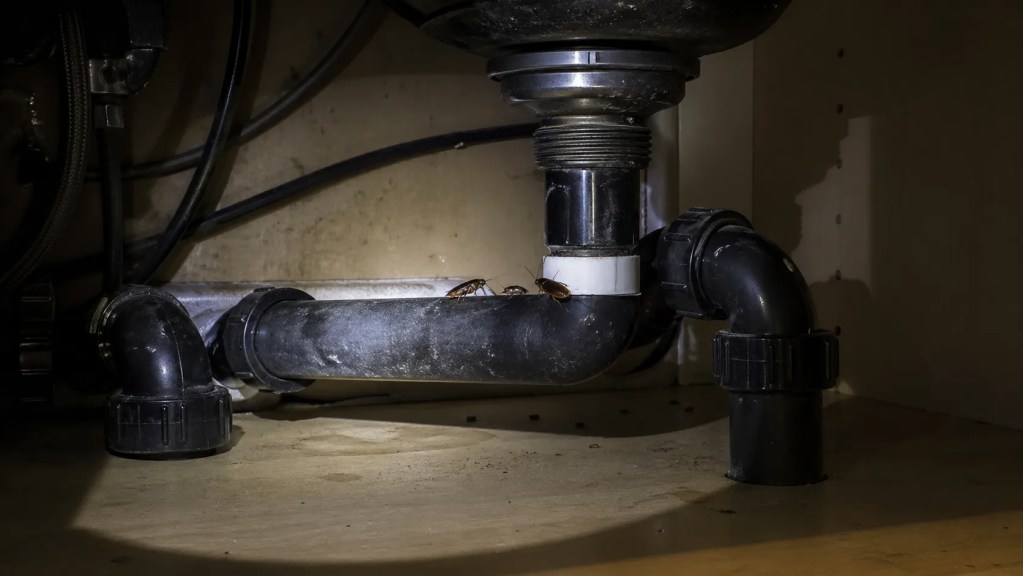
The spread of cockroaches between apartments in Park Extension following invisible pathways: plumbing pipes, electrical conduits, cracks in party walls. Dense, multi-unit, historic—Park Extension concentrates the very conditions that turn an isolated infestation into a building-wide problem. A triplex on Hutchison Street or an apartment block near Parc metro station might see a colony of German cockroach German cockroach colonizes three floors in less than six weeks.
The German cockroach is the dominant species in Montreal residential buildings. Flat. Fast. Nocturnal. It can slip into spaces as narrow as a piece of cardboard. In the area's older buildings—constructed before 1960, with cracked plaster walls and unsealed pipes—every plumbing joint under a sink becomes an inter-apartment highway. Understanding this mechanism is the first step to breaking the chain of contamination.
- The German cockroach (German cockroach) spreads mainly through plumbing and electrical conduits, especially in buildings constructed before the 1970s.
- A single infested dwelling can contaminate 4 to 6 neighboring apartments in a few weeks if the passages are not sealed.
- Early signs include black droppings (frass) around the sink, a persistent musky odor, and shed exoskeletons behind the household appliances.
- In an apartment building, a slow-acting transfer insecticide gel (hydramethylnon or low-dose fipronil) applied to all units simultaneously is the most effective method recommended by professionals.
- The landlord has a legal obligation to act according to the Régie du logement. — The tenant must report the infestation in writing as soon as it is first observed.
How cockroaches do they spread between homes in an apartment building?
The lateral spread of cockroaches in an apartment building occurs primarily through three physical pathways: the spaces around plumbing pipes, shared electrical conduits, and cracks in adjoining walls. In an unsealed building, a colony established in a ground-floor apartment reaches the second floor in less than a month.

The German cockroach is particularly formidable because it carries its eggs in an ootheca—a rigid capsule attached to its abdomen—for up to 24 hours before hatching. It rarely moves in the open during the day; it prefers confined, warm, and humid spaces. Under sinks, behind refrigerators, in electrical boxes: that's where it moves, unseen, from one dwelling to another.
In Parc-Extension buildings—especially the triplexes and plexes on Liège Street, Ogilvy Street, or Boulevard Saint-Laurent North — shared plumbing columns are practically never insulated between floors. Each unsealed pipe penetration represents a breach. A twelve-unit building can have dozens of these transit points. This is why treating a single apartment systematically fails: the roaches take refuge in adjacent apartments during treatment, then return.
In May 2025, several residents in the area around Sir-Wilfrid-Laurier Park reported repeated reinfestations linked to exactly this phenomenon – a partial treatment in a single apartment, without coordination with neighboring units, had left the plumbing corridors intact. The cockroach is a survivor. It bypasses. It waits.
What are the signs of an infestation who is advancing within the walls rather than in a single dwelling?
An active infestation in multiple dwellings is indicated by simultaneous signs among several residents: frass (granular black excrement) near water pipes in several kitchens, the appearance of live cockroaches in dwellings with no accessible food source, and an unexplained musky odor originating from the walls. These combined signals point to an established colony within the common infrastructure.
Cockroach droppings are the best indicator. These small, black droppings, 1 to 2 mm in size, resemble coarsely ground pepper. They are found concentrated around pipe joints, behind electrical outlet plates, and under pantry shelves. They leave slight stains if rubbed. Translucent and fragile exoskeleton molts (exuviae) confirm active reproduction on-site. A brownish, empty ootheca found behind a drawer indicates that cockroaches have been reproducing in this location for at least three weeks.
This week on a duplex Rosemont, a technician found a colony of two hundred individuals nestled in the cavity behind the showerhead — a space of 8 cm, warm, humid, directly connected to the neighbor's adjoining wall. Neither tenant had noticed any cockroaches in their kitchen. The infestation lived entirely within the wall.
Other signs to watch for: cockroaches active during the day (a sign of overpopulation - individuals are driven out of their hiding places by density), elongated brownish stains on walls around ducts (pheromonal secretions from aggregations), and presence in unusual places like bathrooms or unfinished basements. These signals indicate an expanding colony.
DIY or exterminator: what approach for stop the spread in buildings in Parc-Extension?
In multi-unit dwellings, DIY treatments (over-the-counter products) are not enough to stop lateral spread. Aerosol insecticides drive cockroaches away without eliminating them, pushing them into neighboring units through the same conduits. Professional, coordinated intervention in all units — or at a minimum, in adjacent units and common areas — is essential to break the cycle.
| Criterion | DIY treatment | Professional intervention |
|---|---|---|
| Treatment scope | Housing only | Coordinated whole building |
| Products available | Aerosols, adhesive traps (over-the-counter) | Hydramethylnon gel, low-dose fipronil, registered insecticides |
| Effect on propagation | Push the insects back to the neighbors | Slow transfer: workers contaminate the colony |
| Duct access | Surface visible only | Injection into cavities, plumbing joints, electrical boxes |
| Multifamily housing coordination | Impossible without owner's permission | Global action plan, owner-planned access |
| Risk of re-infestation | Very High (colony not eliminated) | Reduced if all units treated simultaneously |
Slow-acting insecticide gel is key. Applied in small dots in crevices (under sinks, in outlet boxes, behind refrigerators), it's not detected as a threat by roaches. They consume it, then [they] contaminate their counterparts through contact and their droppings. Within 72 hours, a cascade of deaths is triggered in the colony. But this mechanism is only effective if the gel is applied in each affected dwelling—otherwise, individuals from untreated units quickly recolonize.
What are the landlord's obligations for a Cockroach infestation in multi-unit dwelling in Quebec?
In Quebec, the owner of a rental property is legally required to maintain the dwelling in good habitable condition, which includes controlling infestations of vermin. As soon as a tenant reports the presence of cockroaches in writing, the owner must act within a reasonable time. Failure to do so constitutes a breach of their obligations under the Civil Code of Quebec and the Régie du logement.
Specifically, the landlord must hire an exterminator certified by the RBQ to inspect and treat all affected units, not just the unit of the complaining tenant. They must also ensure access to common areas—unfinished basements, technical rooms, plumbing shafts—so that the treatment is complete. If the landlord delays or refuses to act, the tenant can file a request with the Régie du logement to obtain a rent reduction or force the repairs.
From the tenant's perspective, the obligation is to report quickly—ideally by email or certified letter—and to cooperate with access for treatments. A tenant who refuses entry to the exterminator compromises the effectiveness of the global plan and can be held responsible for the continued spread. In a building in Parc-Extension where units share plumbing risers, a single refusal is enough to thwart the entire eradication strategy.
The City of Montreal, through its housing standards bylaws, can also intervene if the owner is negligent. A municipal inspector can issue a notice of infraction and order the work to be done. Buildings in the Jean-Talon West sector, bordering Parc-Extension, have been the subject of several such inspections in recent years due to the density and age of the buildings.
How to effectively caulk for prevent cockroach migration between apartments?
Caulking transit points is the most effective preventive measure to block the lateral spread of cockroaches within a building. Every pipe chase, electrical conduit, or vent duct that passes through a shared wall or floor represents a potential migration pathway. Filling these openings with acrylic caulk or steel wool (for large spaces) physically cuts off highways between units.
Here are the steps for effective preventive caulking in an apartment:
- Identify all pipe runs under the kitchen sink, under the bathroom vanity, and behind the toilet — these are the most common entry points.
- Check the electrical outlet boxes On shared walls: unscrew the plate and examine if the cable enters an open space. Seal with an approved fire-resistant product.
- Seal cracks in the floor around heaters and radiators, especially in old buildings with wooden floors.
- Treat the joint between the top of the baseboard and the wall in damp rooms — bathroom, kitchen, laundry room.
- Do not neglect the space under the doors Common areas (hallway, basement): a door sweep significantly reduces traffic.
In June 2025, an increase in reports in Parc-Extension coincided with the start of renovations in several buildings on Boulevard de l'Acadie — the work had opened up wall cavities without prior sealing, releasing colonies that had been established in the partitions for years. Prevention must precede work, not follow it. A certified technician can map transit points before any renovation and recommend appropriate materials according to the type of partition — plaster, drywall, concrete.
And in the neighboring neighborhoods?
- Villeray Numerous pre-war duplexes and triplexes on Jarry and Bélanger streets, with plumbing risers similar to those in Park Extension.
- Rosemont–La Petite-Patrie — High density of plexes on Masson and Beaubien streets, where inter-unit spread regularly affects rental buildings.
- Côte-des-Neiges Numerous multi-family buildings around Queen Mary Road, with a highly mobile tenant base favoring re-infestations.
- Plateau-Mont-Royal Old apartment buildings on Saint-Joseph Boulevard and Duluth Street with frequent plaster cracks, a classic breeding ground for cockroaches.
- Outremont — Upscale buildings on Bernard and Laurier Avenues whose shared unfinished basements facilitate the discreet migration of German cockroaches.