
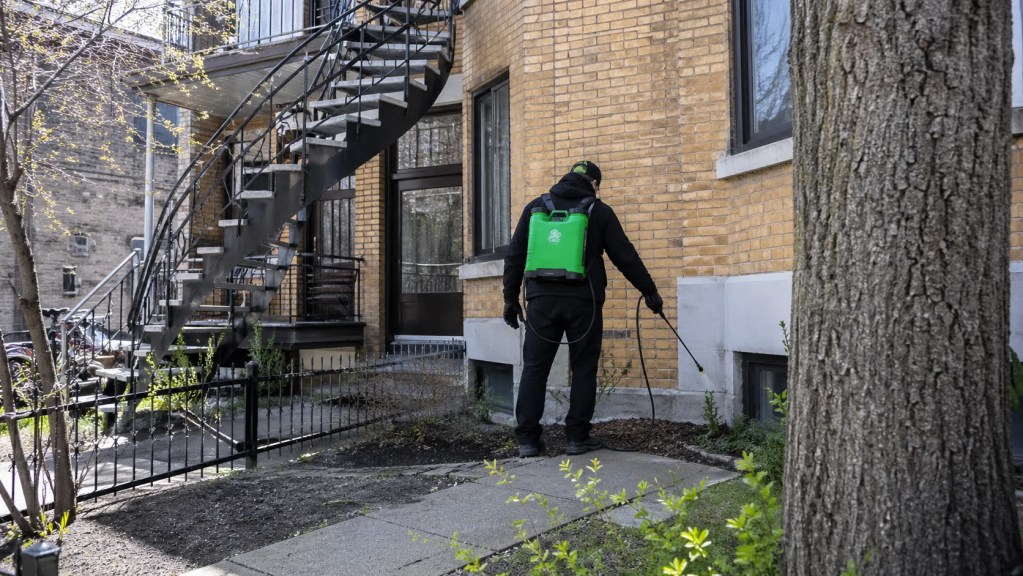
In Villeroy, where row houses are lined up on streets like Jarry, Bélanger, and Saint-Zotique, the preventative outdoor spraying represents one of the most effective interventions for nipping pest invasions in the bud before they even cross the threshold. As soon as spring temperatures stabilize — usually between mid-April and the end of May — the carpenter ants, woodlice, spiders, and wasps actively seek to enter buildings through foundations, caulked joints, and the undersides of crawl spaces. Acting proactively transforms your building's exterior facade into a true chemical protective barrier.
In a densely populated residential neighborhood like Villeray, the unique nature of multi-unit apartment buildings multiplies entry points and surfaces of contact with the ground. A well-structured spring protocol—complete perimeter treatment, joint treatment, and residual spraying under balconies—makes all the difference between a quiet season and repeated calls during the summer. Here's how this protocol works in practice, step by step.
What to know about spring preventive spraying in Villeray:
- The best time to spray the exterior of a triplex in Villeray is between mid-April and the end of May, as soon as nighttime temperatures consistently exceed 7°C.
- A complete perimeter protocol covers the foundations, door and window frames, soffits, undersides of decks, and drainage areas – totaling 8 to 14 distinct treatment points on a standard triplex.
- Residual spraying with approved pyrethroids remains active for 30 to 90 days depending on weather conditions and the type of surface treated.
- Villeray triplexes are at increased risk from carpenter ants, pillbugs, and spiders due to the frequent presence of exposed wood beneath porches and poorly ventilated basements.
- A single, well-executed outdoor preventive treatment in the spring can significantly reduce the risk of an indoor infestation throughout the summer season.
Why the Outdoor preventative spraying is it particularly recommended for Villeray triplexes in the spring?
Villeray is a neighborhood built mostly between 1920 and 1960, meaning the vast majority of residential buildings are red brick duplexes or triplexes, featuring wooden galleries, basements with fieldstone or concrete block foundation walls, and enclosed backyards. This typical architecture creates ideal conditions for the hibernation of many pests which, as soon as the thaw arrives, actively migrate toward sources of heat and moisture.
Unlike a detached single-family home, a triplex shares its walls with two immediate neighbors. An infestation at a neighbor's can spread quickly from one unit to another, particularly through cracks in masonry walls, plumbing penetrations, or floor joists. Preventive exterior spraying acts as a first line of defense by creating a residual barrier before insects have had a chance to infiltrate.
The most frequently intercepted pests during spring treatments in Villeray are:
- Carpenter ants — particularly active as soon as the ground temperature exceeds 10°C, they seek out the damp wood in galleries and roof edges
- Woodlice and springtails — favored by poorly calibrated drainage areas and planters attached to the foundations
- Spiders and centipedes — that follow their prey (midges, springtails) indoors through foundation cracks
- Wasps and bumblebees — who begin to explore the soffits and gallery coffers to establish their nests as early as the end of April
- Bed bugs in transit — in high-turnover rental buildings, common areas and balcony exteriors can serve as pathways between dwellings
⚠️ To remember: In triplexes where tenants change frequently, spring exterior preventive treatments should ideally be coordinated with the landlord before new tenants arrive on July 1st. A building treated in May is significantly better protected for Quebec's major moving day.
What are the concrete steps for Full perimeter protocol on a triplex in Villeray?
A comprehensive perimeter protocol on a triplex villerois includes several distinct phases, each targeting a specific area of the building. The technician begins with a visual inspection before any application to identify high-risk areas, active cracks, moisture accumulation, and signs of existing activity.
Inactive
Inactive
Preparation
Perimeter treatment
Full spray
Active surveillance
Retreatment if required
Residual follow-up
Autumn treatment
End of season
Inactive
Inactive
Here are the steps in usual execution order:
- Initial perimeter inspection (15-20 minutes) — Complete building tour to identify foundation cracks, deteriorated caulking, vegetation debris accumulation, wood in direct contact with the soil, and standing water.
- Foundation strip treatment — Spraying a pyrethroid-based residual product (bifenthrin or lambda-cyhalothrin approved by Health Canada) on a 30 to 45 cm high band around the entire circumference of the foundation, with emphasis on internal corners and concrete/brick junction areas.
- Door and window frames on the ground floor — Application targeted to dormant areas, thresholds, and degraded silicone joints. Basement doors and cellar windows receive particular attention as they represent the most frequent entry points.
- Underside of front and rear galleries The wooden galleries of Villeray's triplexes are often partially dilapidated beneath their decking, with gaps between the boards that provide ideal shelter for wasps and spiders. The technician sprays under the gallery floor and on the support posts.
- Fascias and Soffits — Using an extension wand, treat aluminum or vinyl soffits to discourage yellow jackets and bald-faced hornets from nesting.
- Yard drainage and sump pits — Application of an insecticide granule around drainage openings and damp areas in the backyard to control ants and pillbugs.
- Post-processing report — Documentation of treated areas, products used, and follow-up recommendations for the building owner or manager.
The entire protocol for a standard-sized triplex (approximately 25 feet facade, two balconies) generally takes between 45 minutes and 1.5 hours, depending on the condition of the building and the accessibility of the areas to be treated.
What products are used during a Outdoor residual spraying And are they safe for residents and pets?
Products used for outdoor preventive spraying in Quebec must be approved by Health Canada (DGSN registration number) and applied by a certified technician holding a permit issued by the MELCCFP (Ministry of Environment, Fight Against Climate Change, Wildlife and Parks). In Quebec, the Pesticide Management Code strictly regulates application rates, areas, and minimum distances to be respected in relation to water bodies and vegetable gardens.
The most commonly used product families for preventive outdoor use are:
- Synthetic pyrethroids (bifenthrin, lambda-cyhalothrin, cyfluthrin) — act on the insect nervous system by contact or ingestion, offer a residual effect of 30 to 90 days depending on the surface and exposure to UV and rain. They are classified as having low toxicity for mammals at approved application rates.
- Neonicotinoids in localized application — sometimes used as bait or in granular form around ant zones, under strict control given their potential impact on pollinators.
- Diatomite-based products (diatomaceous earth) — used as a supplement in dry areas, with no chemical residue, mechanically effective against hard-shelled insects.
For the safety of residents, the technician generally recommends staying away from treated areas for a period of 2 to 4 hours after application, which is the time it takes for the product to dry completely. Pets, especially cats that roll on the floor, should be kept indoors during this period. Once dry, the residual deposit does not pose a significant risk to humans or pets, according to the safety data sheets for products approved in Canada.
Visit MELCCFP Pesticide Management Code specifies the legal obligations of pesticide applicators in Quebec, including the requirement to notify residents prior to any application in dense residential areas.
⚠️ Points of attention for triplex owners: If your building is adjacent to a community garden or green space, the technician must respect buffer zones defined by the Pesticide Management Code. Inform your exterminator of this before the appointment so they can adjust their protocol accordingly.
How often does it need to be renewed preventative outdoor spraying on a residential building in Villeray?
The ideal frequency of treatment depends on a number of factors specific to your building and its immediate environment: the presence of mature trees nearby (especially maples and basswoods, which attract ants), the state of caulking, humidity levels in the basement, and the infestation history of previous years.
As a general rule, exterminators recommend the following schedule for a triplex in Villeray :
- Spring treatment (mid-April to end of May) - This is the most important treatment of the year. This is the most important treatment of the year.
- Summer follow-up treatment (July) - recommended if the season is particularly rainy (rain dilutes pyrethroid residues on exposed surfaces) or if insect pressure is observed on the building.
- Autumn Treatment (late August to mid-September) — optional but very useful for preventing wasps, spiders, and woodlice from hibernating in building cavities before the first frosts.
For a building with no significant history of infestation and well-maintained, a single spring preventative treatment is often sufficient to protect the entire season. For a triplex with a damp basement, confirmed presence of carpenter ants in previous years, or wood degraded beneath galleries, a program of two or three visits is generally advised.
It is also important to distinguish between preventive treatment—which aims to prevent establishment—and curative treatment—which is carried out after an infestation is established. Properly executed preventive treatment consistently costs less in resources and disruption for tenants than curative treatment during the peak summer season.
How to prepare your Villeray triplex for maximum efficiency Spring perimeter spraying ?
Building preparation before the technician arrives is an often underestimated but crucial step for treatment effectiveness. A well-prepared space allows for more precise application, better product adhesion to surfaces, and unobstructed access to all critical areas.
Here are the concrete actions recommended for the 24 to 48 hours before the procedure:
- Clear the area around the building Remove flower boxes, garden furniture, bicycles, and any other items stored against the foundation. The technician must have access to a strip of at least 60 cm around the foundation.
- Trim vegetation in contact with the building Bushes, perennials, and hedges placed against the foundation wall or under overhangs create green bridges that facilitate insect passage. Cut them back at least 30 cm from the wall before treatment.
- Remove accumulated plant litter Dead leaves, decorative bark mulch, and compost along foundation borders are preferred overwintering sites. Removing them before treatment eliminates existing refuges.
- Report problem areas to the technician — If you observed signs of activity (sawdust under a gallery, columns of ants, borer galleries) the previous year, note their locations to inform the technician upon their arrival.
- Provide access to the backyard In Villeray's triplexes where backyards are sometimes blocked by a locked fence or shared with a neighbor, coordinating access in advance avoids wasted time and untreated areas.
- Inform tenants — The building owner or manager must notify tenants at least 24 hours in advance, ideally 48 hours, in accordance with the obligations of the Régie du logement. Tenants must be informed to stay away from treated areas and to put away children's toys and pet bowls.
Once treatment is complete, avoid watering the perimeter of the building or washing galleries with a hose for at least 72 hours to allow the product time to properly bond to porous surfaces like brick and concrete. Light rain after 24 hours will generally not compromise the treatment if surfaces have dried well.
⚠️ Owners reminder: According to the Quebec Pesticide Management Code, all applicators must provide the owner or occupant with a treatment notice specifying the products used, the areas treated, and the precautions to be observed. Keep this document—it will be useful if a tenant or health authority requests it.
And in the neighboring neighborhoods?
- Rosemont–La Petite-Patrie - Neighborhood adjacent to Villeray, with a similar housing stock of brick triplexes: same perimeter protocol recommended in spring to control carpenter ants and wasps.
- Saint-Michel Dense sector of multiple rental buildings where preventive exterior spraying is particularly effective in protecting older building foundations.
- Parc-Extension — A high-density housing area where spring perimeter treatments help prevent pest migration between closely spaced neighboring buildings.
- Plateau-Mont-Royal — Historic district with century-old duplexes featuring numerous exposed wooden galleries: the soffits and undersides of these galleries are prioritized during spring maintenance protocols.
- Ahuntsic-Cartierville — Residential sector north of Villeray with a strong presence of carpenter ants linked to large mature trees: preventive perimeter spraying is recommended starting mid-April.