
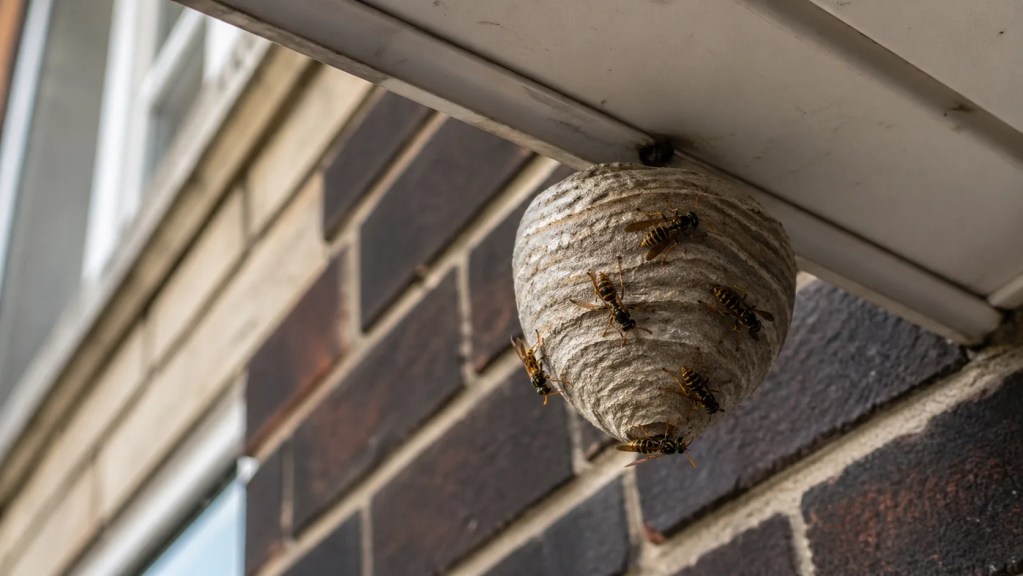
Starting mid-May in Parc-Extension, the rains return, the gardens awaken—and queen wasps emerge from hibernation to choose a nesting site. It is precisely during this period that spotting a Beginner's wasp nest makes all the difference: a golf ball-sized nest can be treated in minutes, whereas a mature nest in August can house several thousand aggressive individuals. In a densely built neighborhood like Parc-Extension, where duplexes, triplexes, and alleys are common, early detection protects your family and your neighbors alike.
The neighborhood has several characteristics that favor the rapid establishment of colonies: aging wooden soffits, uninsulated metal sheds, dense cedar hedges along fences, and little-used spaces under back decks. Knowing how to read the first signs — even before the nest is visible to the naked eye — allows you to act early, limit the risk of stings, and avoid an infestation that, left untreated, becomes unmanageable by July.
What to know about early identification of a wasp nest in May in Parc-Extension:
- The queen begins to build alone starting in late April or early May: the initial nest resembles a small, ribbed, grayish sphere, 2 to 5 cm in size, often under an overhang or in a shed.
- The most reliable sign of a beginner nest is the repeated presence of 1 to 3 wasps flying in slow circles around the same fixed point on an exterior structure.
- In May, the nest contains only a few cells and no workers: this is the safest intervention window of the entire season.
- In Parc-Extension, the areas most at risk are deteriorated soffits, spaces under porches, seldom-used sheds, and cracked masonry joints.
- Never attempt to remove a nest yourself, even a small one: a queen in the foundation phase actively defends her nest and can sting multiple times.
What are the very first visual signs of wasp nest What is forming in May?
In May, the nest of a nascent colony is almost invisible from a distance. The founding queen—the sole survivor of winter—works alone for several weeks before the first workers hatch. The result of this solitary labor is a tiny, gray-brown papier-mâché structure, made of chewed wood fibers mixed with the insect's saliva. At this stage, here's what you'll concretely observe:
- A small grayish, round or oval-shaped mass, the size of a walnut or golf ball, often attached under a horizontal surface: below a cornice, inside an outdoor electrical box, in a soffit.
- A ribbed and layered texture, resembling crumpled paper, with a single small entry hole visible at the bottom or side.
- A single wasp who enters and exits this orifice regularly — it's the queen herself supplying the nest.
- Small grayish wood shavings on nearby aging wooden surfaces: the queen scratches painted or unfinished surfaces to collect her raw material.
What distinguishes a beginner's nest from a simple passing insect is the regularity of behavior. If you see the same wasp return to the same spot every 10 to 20 minutes for several consecutive days, you are almost certainly dealing with a colony foundation. Note the exact location, observe without approaching, and contact an exterminator before the first workers hatch — usually between 4 and 6 weeks after construction begins.
Where to look for a Beginner's wasp nest in a typical duplex or triplex in Parc-Extension?
Parc-Extension's residential architecture offers a multitude of micro-shelters that founding queens systematically exploit. Unlike suburban areas where nests are often found in trees or hedges, in dense urban environments, wasps favor built structures that offer protection from rain and predators. Here are the priority areas to inspect starting in mid-May:
- Wooden soffits and fascias Cracks, loose joints, or sections of rotten wood represent ideal entry points. Look at the angles between the wall and the roof, especially on the backyard side.
- The inside of sheds and outbuildings The upper corners, behind stored items, under ceiling-mounted shelves. Infrequently used metal sheds are particularly favored.
- Under the rear galleries and balconies the wooden beams of the second or third floor galleries, especially where the paint is flaking.
- Cracked masonry joints : certain species like the yellow jacket (German yellowjacket) establish themselves in wall cavities accessible through a crack just a few millimeters wide.
- Outdoor electrical boxes and meters The spaces behind the metal lids offer warmth and darkness—ideal conditions for starting a nest.
- Under the metal stairs Yellow-legged wasps particularly favor hollow spaces under painted metal stairs, especially in alleyways.
⚠️ To remember for your inspection: Tour your building early in the morning (before 8 AM) when temperatures are cool and wasps are still relatively inactive. Maintain a minimum distance of 3 meters from suspicious areas. Never use a flashlight directly pointed at a potential opening – the light can trigger a defensive reaction even in May.
How to distinguish a wasp nest From a nest of hornets or bees in the initial stage?
In May, before colonies become established, nests from different species can appear almost identical to the untrained eye. However, correctly identifying the species is crucial for choosing the right intervention strategy. Here are the key distinctions:
| Criterion | Intervention in May | Wait until August |
|---|---|---|
| Nest size | 1 queen, 5–20 workers | 200–500 workers |
| Nest visibility | Small exposed structure | Often hidden behind a wall or in a cavity |
| Risk of sting | Very low | Raised — aggressive defense of the nest |
| Eradication deadline | One visit is enough | 2 to 3 visits + return visits per month |
| Probability of recurrence | Almost none in the same season | The nest might be in the wrong place. |
| Occupant comfort | Stress minimal | Court Usage Restrictions |
- Yellowjacket waspsVespula spp.) : Gray-brown paper-spherical nest, with a smooth outer envelope. In May, it resembles a small, crumpled paper lantern. The entrance is single, round, at the bottom of the nest. These species often nest in cavities (walls, abandoned mouse nest interior, inside of a partition).
- Yellow-legged wasps or paper wasps (Eastern paper wasp) : nest shaped like an inverted umbrella, with no outer casing—the hexagonal cells are directly visible. It is suspended by a short stalk under an overhang or railing. Much more common in Park Extension than the hornet.
- HornetsBald-faced hornet, bald-faced hornet Large, ovoid nest with an outer surface marked with cream-white and black bands. In May, a beginner nest of this species can be 8 to 12 cm and resembles a bicolor papier-mâché ball. More frequently found in trees or shrubs.
- Bumblebees and bees They do not build paper nests. If you observe an accumulation of golden-yellow wax or a dull buzzing through a wall, it is most likely bees in a cavity. Treatment is different and, in the case of honeybees, relocation by a beekeeper is preferable to extermination.
The simple rule for the general public: If you see exposed hexagonal cells without an envelope, it's a polistes wasp; if the nest is wrapped in a paper casing, it's a yellowjacket or a hornet. In both cases, professional intervention is recommended as soon as the nest is confirmed, regardless of its size in May.
Why is May the time the most strategic to deal with a wasp nest in Montreal?
The biology of social wasps follows an exponential growth curve over the summer. Understanding this timeline helps to grasp why intervention in May on a nascent nest is incomparable to intervention in July on an established colony.
- Mai (foundation): 1 queen, 5 to 30 cells, no workers. The nest is the size of a golf ball to a tangerine. Minimal risk of stinging if a reasonable distance is maintained. Simple and quick treatment.
- June (initial growth): The first workers hatch. The colony reaches 50 to 200 individuals. The queen stops leaving the nest. The workers begin to actively defend the perimeter.
- July–August (peak): A mature colony of German yellowjacket can contain between 3,000 and 15,000 individuals. The nest can be the size of a basketball. Interventions require full protection and specialized expertise.
- September (aggressive phase): The production of new queens and drones alters the colony's behavior. The workers, no longer having larvae to feed, become particularly aggressive and unpredictable. This is the most dangerous time of year for accidental stings.
According to the National Public Health Institute of Quebec (INSPQ), wasps stings are one of the leading causes of severe allergic reactions in Quebec during the summer, with a risk of anaphylaxis for sensitized individuals. Early intervention, in May, not only prevents the destruction of a colony of several thousand individuals but also drastically reduces the risk of stings for residents and allergic individuals in the immediate vicinity.
⚠️ Important Reminder: In Parc-Extension, residential density means your neighbor's nest can pose a risk to your own property. A nest established in a shared wall or a contiguous building's soffit can easily lead to an infestation in your apartment through cracks or gaps around electrical wiring. Communication between co-owners and tenants is essential at the first signs.
What to do concretely when you spot a wasp nest in development In his yard in Park Extension?
Discovering a nascent nest in May is good news: you have time to act safely and effectively. Here's the step-by-step process:
- Confirm identification without approaching. Observe the activity from a distance of 3 to 5 meters. Take photos with your phone's zoom. Note the time of observation and the frequency of comings and goings.
- Mentally define the safety zone. Avoid using mowers, blowers, or noisy tools within 5 meters of a suspected nest. Vibrations and high-pitched sounds can trigger a defensive reaction even from a nest with only a few cells.
- Inform other residents of the building or dwelling. If you are a tenant, report the situation to your landlord in writing (text, email). The cost of pest control is generally the landlord's responsibility in the context of a Quebec residential lease.
- Do not use over-the-counter products (aerosol cans, household cleaners). These products irritate the colony without necessarily destroying it, and can transform a calm nest into an aggressive one. On an incipient nest, a poorly executed application often causes the queen to move her colony to a deeper cavity, making future intervention much more complex.
- Call a certified exterminator upon confirmation. A professional will be able to identify the species, the exact location of the nest, and apply a targeted treatment with appropriate protective equipment. In May, intervention on a developing nest generally takes less than 30 minutes.
Once the intervention is complete, remember to correct the conditions that allowed the nest to be established: caulk the gaps in the soffits, repair open masonry joints, seal the spaces around electrical wires entering the building. These preventive measures significantly reduce the risk of recurrence the following year, as new queens often explore the same locations as those used by previous colonies.
And in the neighboring neighborhoods?
- Villeray - A dense residential neighborhood with many triplexes and tree-lined alleyways: wasp nests frequently settle under galleries and in backyard sheds.
- Rosemont–La Petite-Patrie — The painted wooden soffits of townhouses and community gardens create prime nesting grounds for paper wasps starting in early May.
- Outremont Large properties with mature cedar hedges and seldom-used sheds favor the establishment of yellow-legged wasp colonies that are difficult to detect early on.
- Côte-des-Neiges — apartment buildings and the green spaces of Mount Royal make it a high-risk area for wall cavity nests starting in mid-May.
- Plateau-Mont-Royal - the density of exterior metal staircases and wooden balconies creates numerous micro-shelters ideal for founding queens seeking a location protected from the rain.