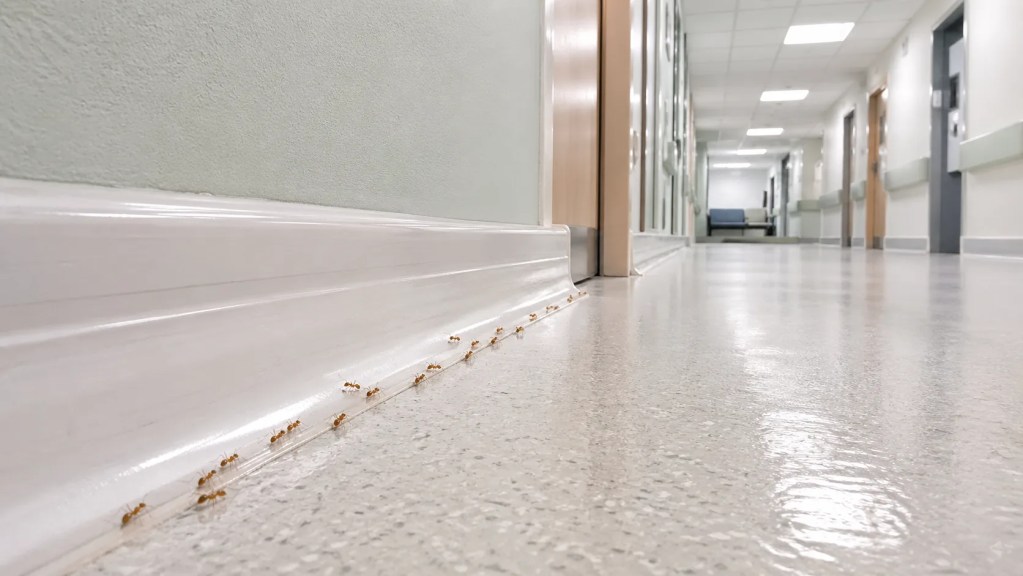
The Pharaoh ants in healthcare settings in Petite-Bourgogne represent a serious microbiological threat that neither heat nor aerosols can resolve without exacerbating the situation. Pharaoh ant, minuscule at 2 mm, sneaks into IV tubing, sterile dressings, and surgical trays — a proven vector of Salmonella, Staphylococcus aureus and resistant opportunistic bacteria. Fast. Silent. Everywhere.
In southwestern Montreal, care facilities lining Saint-Jacques Street and the surroundings of the canal Lachine facing persistent parasitic pressure: triplexes and older buildings in the neighborhood serve as satellite reservoirs, and colonies can have several reproductive queens spread across multiple floors. In May 2026, a notable resurgence was reported in institutional buildings in the Saint-Henri/Petite-Bourgogne sector following heavy rainfall from May 8th to 12th, forcing a review of non-spraying intervention protocols.
- No insecticide spray in active care areas repellents disperse colonies, multiply queens, and worsen infestations in a hospital setting.
- The slow-transfer bait gel (hydramethylnon or low-dose fipronil) is the only compliant method The worker bees bring the active ingredient back to the queen without triggering a colony split.
- Pharaoh ant is polygynous and polydomous A colony can have 10 to 30 queens spread across multiple satellite nests, making any partial approach ineffective.
- The no-break protocol preserves the continuity of care : bait stations are placed outside of aseptic areas, without room closures or patient evacuation.
- Post-treatment surveillance should span 8 to 12 weeks., according to the INSPQ recommendations for establishments at high risk of nosocomial transmission.
Why Pharaoh ant Is it that difficult to eliminate in a healthcare facility?
Pharaoh ant is an invasive tropical species characterized by polygyny (multiple fertile queens per colony), polydomy (multiple interconnected nests), and high tolerance to the ambient heat of year-round heated institutional buildings. This particular biological profile makes any poorly targeted intervention counterproductive: stressing a colony triggers fission, meaning the creation of new satellite nests.
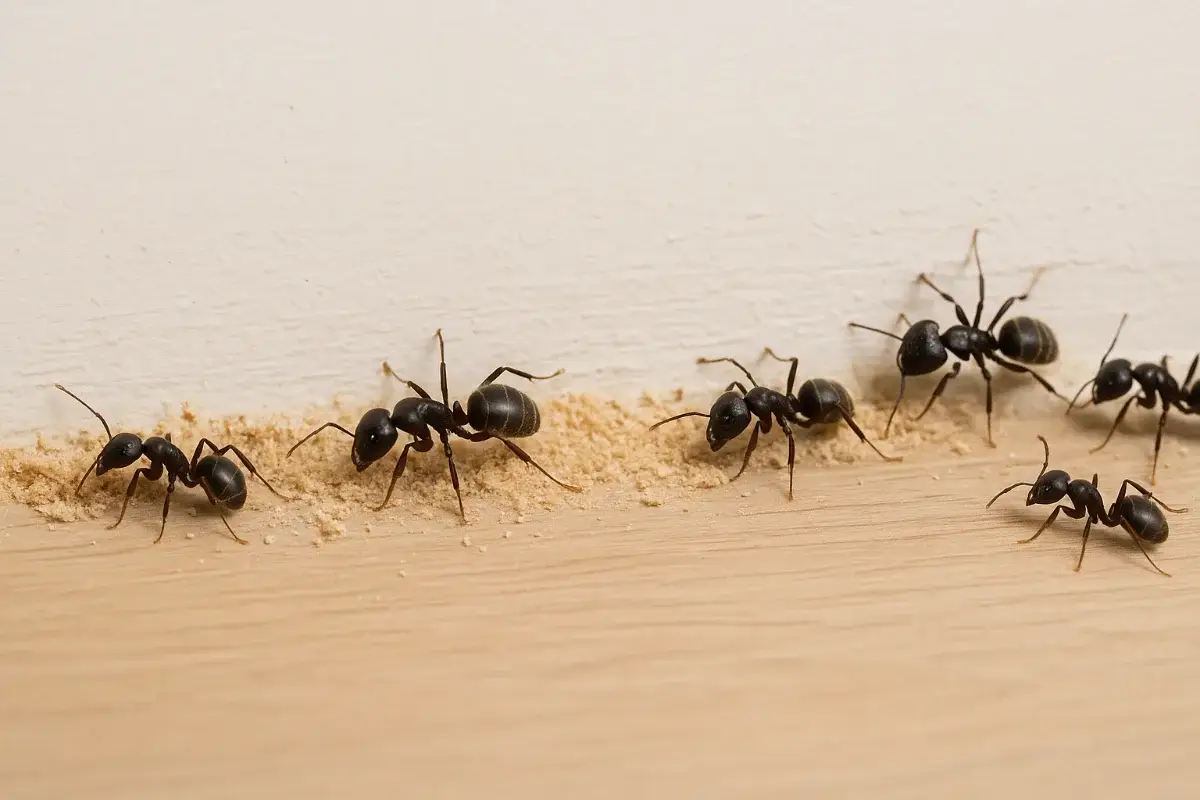
In a hospital or clinic, the conditions are ideal. False ceilings with acoustic tiles, hollow walls with hot piping, service kitchens, and laundry rooms all constitute stable microhabitats. The pharaoh ant does not sleep; it circulates 24/7, using caulked joints, electrical conduits, and drainage pipes.
The health risk is documented. According to the’INSPQ (2023), Pharaoh ant is ranked among the priority mechanical vectors in Quebec hospitals, capable of transporting pathogens from a contaminated surface to sterile equipment in minutes. The colony systematically explores all sources of protein and sugar—glucose sachets, patient purees, poorly sealed collection tubes.
In Petite-Bourgogne, the proximity of old residential buildings—some dating back to the 1920s-1940s, on Coursol Street or Atwater Avenue—creates continuous external pressure. Ants migrate to heated institutions as soon as outdoor temperatures drop below 15 °C, which is about seven months a year in Montreal. Without a physical barrier and an active baiting program, the problem repeats itself season after season.
What are the signs of an active infestation of pharaoh ants in a clinical area?
The first signs of a Pharaoh ant infestation in a clinical area are trails of active workers at night on countertops, isolated ants in sterile supply drawers, or inside packaging for medical devices. Early detection is critical: an untreated colony doubles its colonization area in under six weeks in a heated environment.
Hygiene and sanitation technicians (HSTs) are often the first observers. Here are the concrete indicators to record in the establishment register:
- Live ants on sterile equipment — Dressing packages, packaged syringes, boxed gloves.
- Regular tracks along the baseboards — particularly visible under grazing light, between 10 PM and 5 AM.
- Presence in silicone joints around sinks and hand sanitizing basins.
- Workers' remains in electrical conduits or behind control panels of medical equipment.
- Winged ants in spring, a sign of imminent swarming and a mature colony.
- Tiny frass (granular organic debris) in the upper corners of medicine cabinets.
In a healthcare setting, applying an aerosol insecticide or contact repellent (pyrethrum, permethrin) to a Pharaoh ant colony causes an immediate stress reaction: the colony fragments into dozens of satellite nests, dispersing the queens into previously uninfested areas. This phenomenon of sprouting (scission) transforms a localized problem into a widespread infestation affecting multiple floors. Only the slow-transfer lure gel, positioned outside the aseptic zone, is permitted in an active clinical setting.
How does it work Spray-free baiting protocol for sensitive environments?
The spray-free baiting protocol relies on slow-transfer insecticide gel—hydramethylnon or low-dose fipronil—deposited in microdoses of 0.1 to 0.3 g in closed bait stations. Worker ants ingest the bait, transport it to the colony through trophallaxis (mouth-to-mouth exchange), and gradually contaminate queens and brood over a period of two to six weeks.
The deployment follows a prior mapping of active trails, carried out with bait strips (sugar bread + soybean oil) placed 48 hours before the intervention. This step avoids random placement and concentrates the bait where worker traffic is maximal. In a clinical environment, mapping systematically includes technical premises, crawl spaces, and accessible ventilation shafts.
Bait stations - opaque plastic housings of the Advance 375A type or equivalent certified - are placed:
- In the suspended ceilings, above the acoustic tiles, at intervals of 3 to 5 meters along the detected pathways.
- Under the service kitchen baseboards, behind the refrigeration appliances.
- In piping voids, attached to existing supports without additional drilling.
- Outside aseptic areas (operating room, sterilization room) - never inside.
The gel is reapplied every two weeks for the first eight weeks. A 70% reduction in worker traffic by week 4 is a reliable indicator of success. This week on a duplex of Rosemont Converted into a senior living facility, a technician noted zero live ants at the control station as of week 5, confirming the protocol adapts as well to residential healthcare buildings as to institutional clinics.
What is the responsibility of the building manager in the event of a Pharaoh ant infestation in an institutional setting?
In a Quebec institutional setting, the building manager or health facility operator is legally responsible for maintaining premises free of biological contamination vectors. An untreated documented infestation of pharaoh ants constitutes non-compliance with the standards of the Ministry of Health and Social Services (MSSS) and exposes the facility to sanctions during the AGCC Accreditation inspection or the visit of the Regional Commissioner for Service Quality.
| Responsibility | Building Manager | Tenant / Clinic Operator |
|---|---|---|
| Infestation report | Mandatory upon discovery | Mandatory upon discovery |
| Funding of the intervention | Yes, if the building structure is involved | Yes, if internal behaviors are involved |
| Protocol Selection | Approve (owner) | Validated according to clinical requirements |
| Access to technical areas | Provides access to ducts and voids | Coordinate with healthcare staff |
| Intervention Log | Conservation 5 years (RBQ) | Requirements for Approval and MSSS |
| Post-treatment prevention | Clogging of structural inlets | Dietary Protocols and Waste |
The Régie du logement — now the Tribunal administratif du logement (TAL) — also oversees situations where an infestation affects housing adjacent to medical offices in the same mixed-use building, which are common in converted buildings in Petite-Bourgogne and Saint-Henri. The owner is obligated to act within a reasonable timeframe as soon as they are notified of the problem in writing.
The coordination between the facility's technical teams, the RBQ-certified extermination contractor, and the infection prevention team is non-negotiable. A written plan, signed by all three parties, protects each in case of dispute and facilitates the traceability required during audits.
What long-term preventive measures protect a healthcare facility from Pharaoh ant recurrence ?
Long-term prevention of pharaoh ants in a healthcare facility rests on three interdependent pillars: physical exclusion at entry points, strict management of food sources, and an active monitoring program conducted at set intervals. None of these pillars is sufficient on its own—their combination reduces the risk of reinfestation to less than 10% over a 24-month period, according to available field data.
Physical exclusion: Seal all pipe penetrations through bearing walls with closed-cell expanding foam (acrylic sealant in visible areas), particularly at the junctions between the unfinished basement and the patient care floors. Silicone seals around sinks and wash stations shall be inspected and replaced annually.
Food Source Management: Patient and staff snacks must be stored in airtight containers. Service kitchens must be thoroughly cleaned every evening, including under commercial refrigerators and floor drains—preferred sites for satellite colonies. No unpackaged food should remain unrefrigerated for more than two hours.
Active monitoring program: Monitoring stations (without insecticide, with neutral food attractant) are maintained permanently in risk areas—laundry room, kitchen, suspended ceilings in service corridors—and inspected every 30 days. Any capture triggers immediate reactivation of the baiting protocol, without waiting for the colony to establish.
In Little Burgundy, buildings located within 200 meters of the Lachine Canal bike path and the green spaces of Vinet Park face an above-average risk of spring reinfestation. Pharaoh ants can travel via deliveries, recycled furniture, and even returned laundry carts. An annual monitoring contract with a certified exterminator is the most effective response to this geographical reality.
And in the neighboring neighborhoods?
- Saint-Henri numerous mixed-use buildings (residential + clinic) where Pharaoh ants move between floors via common piping shafts.
- Pointe-Saint-Charles — institutional buildings converted and old housing cooperatives, conducive to polycentric settlements that are difficult to map.
- Griffintown — New high-rise condos with businesses on the ground floor: restaurant kitchens serve as satellite nesting grounds for the residential colonies on the upper floors.
- Verdun — high density of triplexes and senior residences (RPA) where the pharaoh ant represents a regular nosocomial risk in autumn and winter.
- Notre-Dame-de-Grâce Mature residential sector with several private clinics on the ground floor of buildings, exposed to spring migrations from neighboring untreated buildings.