
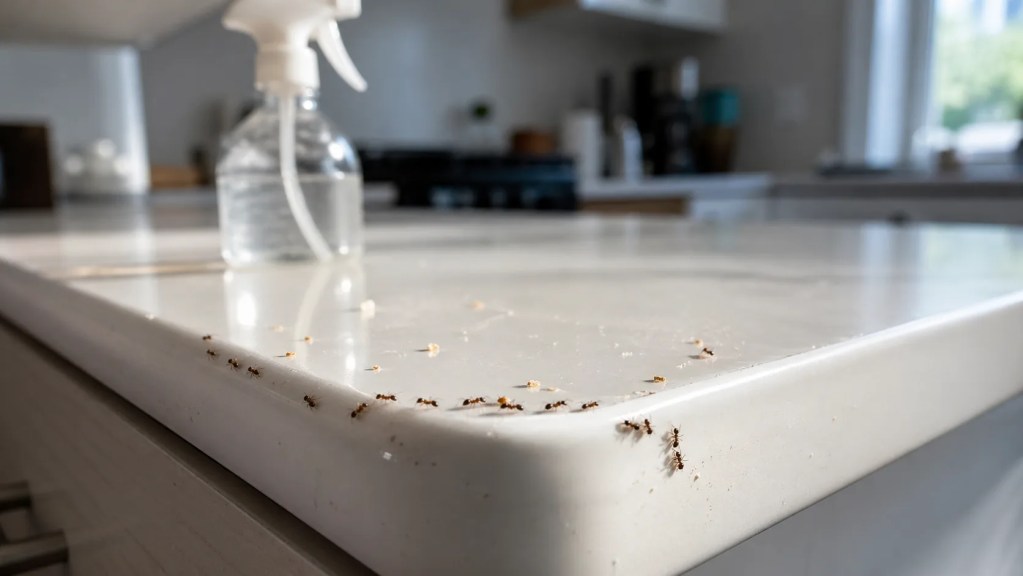
Ant spray in the kitchen is almost everyone's reflex. Practical, fast, available at the local pharmacy - it seems logical. However, in a Triplex or a condo in Verdun, this improvised intervention can turn a minor nuisance into a real infestation. Spraying often makes ant problems in the kitchen worse rather than eliminating them, and understanding why changes everything about how to approach the issue.
Verdun is a dense neighborhood, built tightly between the boulevard LaSalle and Wellington Street. Its old brick duplexes, unfinished basements, and shared yards make it ideal terrain for ant colonies. This spring 2026, several residents in the Desmarchais-Crawford sector have reported massive reoccurrences after using spray products. This is no coincidence.
- The spray kills visible ants but triggers budding the colony divides into several new satellite colonies, multiplying the nests.
- The carpenter ants (Camponotus pennsylvanicus) and the odorous ant (Tapinoma sessile) reacts differently to chemical stress — a single treatment is impossible.
- Killing the worker bees without getting to the queen solves nothing The queen can lay up to 800 eggs per day in response to colony stress.
- Boric acid or hydramethylnon-based bait gels are recommended by Montreal Public Health as an Integrated Pest Management (IPM) approach.
- A landlord in Verdun has a legal obligation (Civil Code of Quebec, article 1854) to ensure the peaceful enjoyment of the dwelling — an untreated infestation exposes the landlord to legal action before the Régie du logement.
Why does the spray cause the Colony budding in the kitchen ants?
Colony budding is a survival mechanism triggered when an ant colony perceives a sudden chemical threat. Rather than dying, the colony fragments: one or more queens leave the main nest with a group of workers to establish new satellite nests at a distance. The result is the opposite of what is hoped for—instead of one colony, you have three or four.
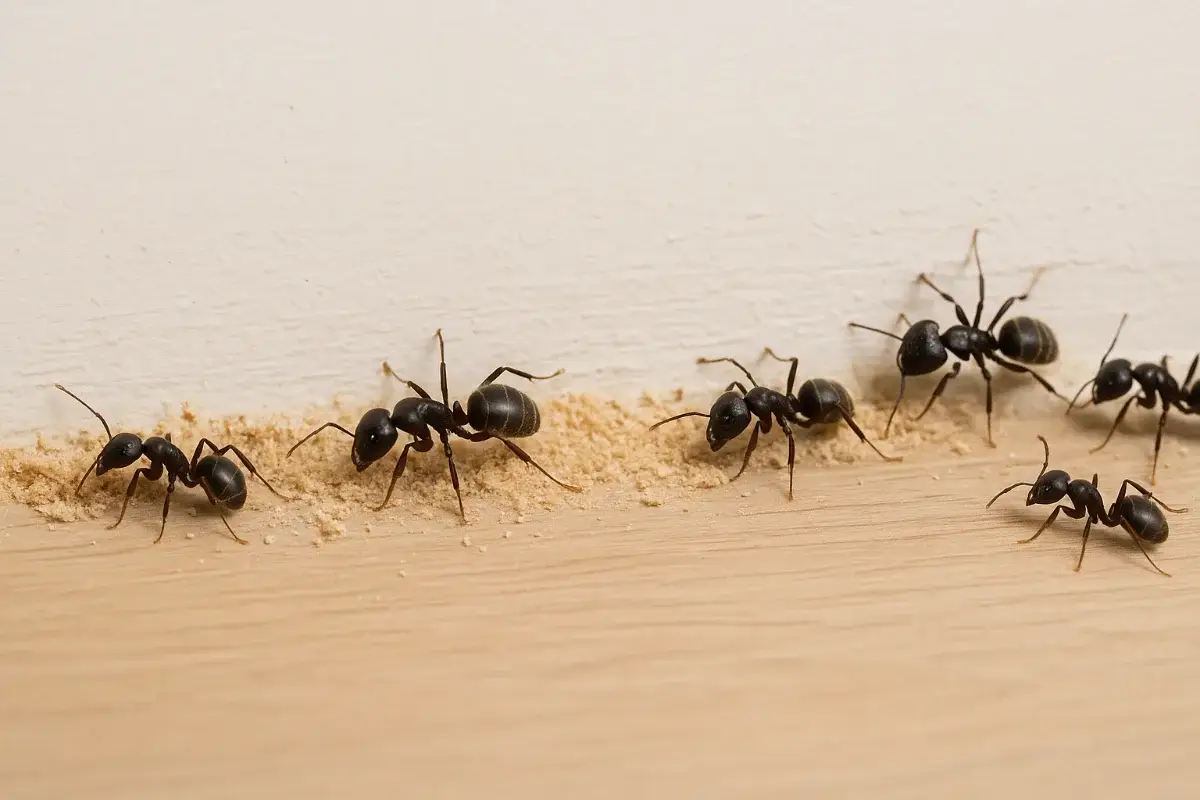
This phenomenon has been particularly well documented in lemon-scented ants (Lasius alienusand the Pharaoh ants (Pharaoh ant), two species common in Verdun homes. The Pharaoh ant, tiny at 1.5 mm, is polygynous—it has multiple queens per colony. An ordinary spray in the ground-floor kitchen sends a chemical alert that causes two queens to migrate to the unfinished basement or the upstairs apartment.
In a typical duplex or triplex on Rue de l'Église or Boulevard de Verdun, shared walls facilitate these migrations. Plumbing columns, cracks in the 1920 foundation concrete, and worn caulking joints form invisible highways. Poorly targeted chemical treatment on the ground floor can therefore trigger an infestation on the second floor within days.
In May 2026, a resident of a studio apartment on Galt Street sprayed the area three times in two weeks. Each time she sprayed, the ants would disappear for 48 hours, only to return in greater numbers. This is a classic sign of active colony expansion. The colony had spread into the wall cavity behind the pantry, out of reach of the spray.
The added problem: aerosol insecticides leave behind a repellent residue. This residue drives the ants away from the treated area without killing them—they simply bypass the chemical barrier and find a new path. You think you’ve eliminated them, but you’ve only rerouted them.
What signs indicate that your ant infestation worsened after DIY treatment?
A worsening infestation following a DIY spray treatment shows distinct signs: reappearance in new, untreated areas; the presence of winged ants (swarming); and the discovery of new satellite nests in areas you hadn’t targeted. These three signs together confirm that the infestation is spreading and that the colony has expanded rather than shrunk.
Winged ants deserve special attention. Their presence indoors in June and July is not insignificant—it’s a sign that the colony has matured enough to reproduce. If you see winged ants after using a spray, the colony had already been established for several years, and the surface treatment did nothing to alter the nest’s underlying structure.
Other signs of worsening to watch out for:
- Ants in new rooms (bathroom, bedroom) when they were confined to the kitchen
- Presence of frass (fine sawdust mixed with insect debris) near baseboards—sign of Black carpenter ant active in the woods
- Visible streaks on walls at different heights, not just at ground level
- Ants returning within 72 hours of each treatment
- Increase in visible entry points despite partial caulking
In older buildings in Verdun—especially those built before 1950 around Willowbrook Park or Riverside Drive—carpenter ants find damp wood that’s ideal for nesting. Sawdust is a key indicator here. A little golden sawdust near a baseboard means that the tunnels are already active within the building’s structure, not just in your kitchen.
DIY or professional: when should you definitely hire a ant treatment to an exterminator?
Entrusting the treatment to a certified exterminator becomes necessary as soon as budding is confirmed, carpenter ants are present in load-bearing structures, or the infestation affects more than one unit of the building. A professional accredited by the MELCCFP uses slow-release gel baits, which forces the workers to bring the active poison back to the queen – the only way to eliminate the colony at its source.
| Criterion | DIY (spray or powder) | MELCCFP Certified Professional |
|---|---|---|
| Effectiveness on the queen | Never reaches the queen | ✅ Gel bait transported to the queen |
| Risk of budding | 🔴 High — triggers fragmentation | 🟢 Low – slow non-repulsive diffusion |
| Satellite colonies | ❌ Multiply nests | Tracking signals to locate satellites |
| Polygyne species (pharaoh) | Contraindicated | ✅ Specific GIE Baiting Protocol |
| Carpenter ants (structure) | Surface only | ✅ Internal gallery treatment |
| Repellent residue | Bypass the tracks - move without eliminating | 🟢 Attractive product — ants are attracted to the bait |
| Multi-unit tracking (duplex/triplex) | ❌ Impossible to coordinate alone | ✅ Landlord-tenant coordination |
Slow-transfer baits (insecticidal gels based on hydramethylnon or low-dose fipronil) are an option for resistant carpenter ants. This solution, approved by Health Canada, generates no repellent residue and acts on contact over a 3-month period, progressively eliminating workers and the queen.
For condominiums and co-ops in the Wellington or Desmarchais area, coordination between units is essential. If your upstairs neighbor is dealing with a spray while you are using gel baits downstairs, the repellent residue from their spray will divert ants towards your bait — creating an artificial influx that distorts the treatment evaluation.
What is the critical season for Ant colonies in Verdun And when to act?
The critical season for ants in Verdun runs from April to September, with peak activity in June-July during swarming. Acting before mid-May—before founding colonies establish their satellites—is the most effective window for intervention. After July, colonies are consolidated and require more intensive treatment.
In April 2026, a significant increase in ant sightings was observed in the Verdun neighborhood following the rains from April 8th to 12th. Excessive moisture in the unfinished basements of old duplexes on Galt Street and Bannatyne Avenue saturated the structural wood, creating ideal conditions for carpenter ants seeking nesting sites.
The seasonal dynamic works like this:
- March-April The overwintering queens emerge from dormancy and begin to lay eggs actively. The first scout workers appear in kitchens.
- May : The colonies establish their food trails—this is the ideal window for preventive baiting.
- June-July: Swarming of winged ants, peaks of activity, maximum risk of budding if undertreated.
- August-September: Consolidation of new colonies founded in summer—a failed spring treatment reveals itself here.
- October-March: winter dormancy, but indoor colonies (Pharaoh ants in heated walls) remain active year-round.
It's this last point that often surprises condo residents in Verdun: pharaoh ants don't sleep in the winter. A building heated to 20°C is, for them, a permanent subtropical environment. Treating in November with a spray in the kitchen is therefore no more effective than in July—and triggers the same budding inside the heated walls.
How to prevent ants in the kitchen permanently without chemical repellent in a Verdun apartment?
Sustainably preventing ants without chemical repellents relies on three combined approaches: eliminating moisture sources (the primary attractant), blocking physical access to structures, and managing food sources in the pantry. According to Public Health Montreal, Integrated Pest Management (IPM) – combining these preventive measures with targeted baiting – is the recommended approach in densely populated residential areas.
In a Verdun triplex, humidity is the most underestimated factor. An unfinished basement with a humidity level above 60% consistently attracts carpenter ants in search of softened wood. A dehumidifier running from May to September, combined with sealant applied to cracks in the foundation, reduces the building’s appeal far more effectively than any spray.
This week, on a duplex on rue de l’Église in Verdun, our team identified three distinct entry points: a detached basement window seal, a crack in the brick mortar on the north facade, and a gap around the cold water supply pipe in the kitchen. These three openings totaled less than 2 mm² combined—enough for thousands of daily passages.
Concrete preventive measures for a Verdun dwelling:
- Seal all plumbing passages with silicone caulk or steel wool (ants do not gnaw through steel)
- Store pantry items in airtight containers—sugar, flour, and breadcrumbs are the #1 attractants
- Eliminate stagnant water under the sink and repair dripping faucet seals.
- Install a physical barrier of diatomaceous earth (DE) at the entrance to at-risk areas—not repellent, acts by cuticular abrasion
- Check window and door seals once a year, especially on the north side where condensation is more frequent.
According to the INSPQ (2023), integrated pest management in residential settings reduces pesticide use by 70 to 80 percent when physical exclusion measures and attractant reduction strategies are systematically applied. Consult the INSPQ's GIE framework (2023).
A point often overlooked in Verdun rental properties: the lease and the Civil Code of Quebec (art. 1910) oblige the tenant to keep the dwelling clean and to report any infestations to the landlord. An informed and inactive landlord may be compelled to act by the Rental Board. Prevention is therefore not just a matter of comfort—it is also a shared legal responsibility.
And in the neighboring neighborhoods?
- LaSalle — Carpenter ants are proliferating in wooded areas near Angrignon Park; single-family homeowners are particularly exposed during the spring budding.
- Pointe-Saint-Charles The concentration of old brick triplexes from the 1920s-1940s creates conditions similar to Verdun; Pharaoh ants are common in multi-unit buildings there.
- Côte-Saint-Paul — Converted industrial sector generates ant migrations to adjacent residences in summer; perimeter baiting recommended.
- Ville-Émard — Green alleys encourage colonies of Lasius alienus that transit to the kitchens; baiting and gel bait treatment in May-June.
- Notre-Dame-de-Grâce — Large properties with mature trees near Décarie Boulevard are home to colonies of Black carpenter ant able to infiltrate unfinished basements.