
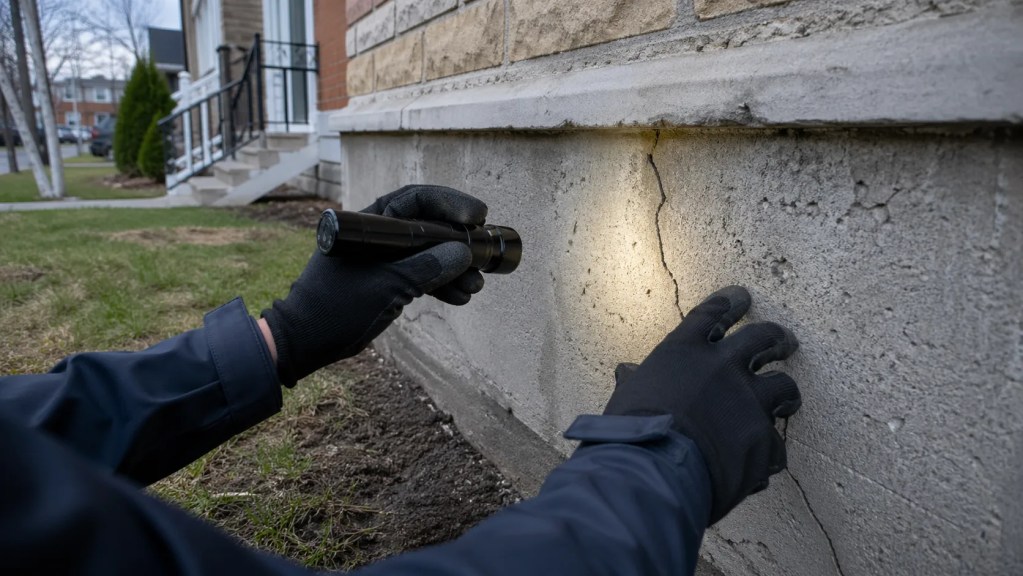
The spring foundation inspection in Montreal-North is an unavoidable step after every Quebec winter. Repeated freeze-thaw cycles exert considerable pressure on foundations—especially on streets bordering Boulevard Léger or older areas near Henri-Bourassa Park. Cracks, water infiltration, concrete crumbling: post-winter damage can worsen rapidly if ignored.
Montréal-Nord has a high density of triplexes and duplexes built between 1950 and 1975, a time when insulation and drainage standards differed significantly from current standards. An unfinished basement often serves as an early indicator of structural problems. Inspecting your foundation yourself starting in mid-April, before the heavy May rains, allows for early detection and helps avoid major repairs — or pest infestations through cracks.
- 8 checkpoints: stair-step cracks, mortar spalling, water infiltration, render delamination, floor heaving, perimeter drain, service penetrations, and construction joints.
- Cracks larger than 3 mm or progressing rapidly require immediate professional evaluation. — they can indicate active movement of the clay soil typical of Montreal-North.
- Spring is the critical season: The snowmelt and April-May rains saturate the soil, revealing the weak points that winter created in the concrete or concrete blocks.
- Cracks in the foundation are prime entry points for pests (mice, garter snakes, carpenter ants) — a foundation inspection is also a preventive pest inspection.
- According to the City of Montreal, the owner is responsible for maintaining the foundation in good condition. — Any failure may result in correction notices from the Housing Service.
What are the 8 points of a Foundation inspection in the spring in Montreal-North?
A spring foundation inspection covers eight specific areas: vertical, horizontal, and stair-step cracks on the foundation wall; the condition of the mortar between blocks; signs of water infiltration; interior plaster detachment; basement floor heaving; the operation of the perimeter drain; the sealing of service penetrations (plumbing, electrical, gas); and the condition of construction joints between the foundation and the slab.

These eight points form a systematic checklist suitable for typical constructions in Montreal-North. Start with the exterior, doing a complete walk-around of the building after the thaw, then move to the unfinished basement interior. Equip yourself with a powerful flashlight, a graduated ruler, and a pencil to mark and measure each anomaly. Note the date of observation—essential for tracking a crack's progression from one spring to the next.
After a winter marked by frequent freeze-thaw cycles, stair-step cracks in concrete block foundations can progress noticeably. This type of crack runs diagonally along the mortar joints and often indicates differential settlement.
- Vertical fissures Measure the width with a ruler; less than 1 mm = monitoring; 1-3 mm = consider epoxy injection; more than 3 mm = professional required.
- Horizontal fissures the most critical — indicate lateral soil pressure. Any horizontal crack in a block foundation wall requires prompt evaluation.
- Stair-step fissures Differential settlement of clay soil, common in northeastern Montreal.
- Mortar between blocks: Probe with a screwdriver; if the mortar crumbles without resistance, repointing is necessary.
- Water infiltration Look for white rings (efflorescence), dark stains, and lime deposits on the walls.
- Coating delamination Tap the plastered walls; a hollow sound indicates detachment and moisture penetration behind the plaster.
- Floor heaving: Place a level on the slab; a measurable rise suggests a drainage or frost problem under the slab.
- Perimeter drainage and penetrations: Check that the foundation drain is not clogged and that each service penetration is properly sealed.
How to differentiate a structural crack from a Shrinkage crack in the foundation ?
A structural crack in the foundation can be distinguished from a shrinkage crack by its width, orientation, progression over time, and context. Shrinkage cracks, caused by the drying of concrete during initial curing, are generally fine (less than 0.5 mm), superficial, and stable since construction. Structural cracks, on the other hand, progress, widen, or cause misalignment between the two edges.
The simplest practical test: place a piece of masking tape on either side of the crack and write the date. Return in 4 to 6 weeks. If the tape has torn or a gap is visible, the crack is active. In 1960s triplexes in Montreal North—like those on Maurice-Duplessis Boulevard—aging concrete is particularly susceptible to this type of movement in the spring.
A vertical offset between the two lips of a stair-step crack is a clear sign of active movement. Ignoring these cracks from one spring to the next allows moisture to build up, which can facilitate the penetration of carpenter ants (Camponotus pennsylvanicus) into adjacent wooden elements.
Efflorescence—that powdery white deposit on walls—often accompanies active cracks. It results from the migration of soluble salts carried by water passing through the concrete. Its presence confirms that infiltration is occurring, even if the crack appears small. Consult the page on mold from Montréal’s regional public health department (in French) to understand the health risks associated with chronic dampness in basements.
When do basement cracks become an entry point for pests in Montreal-North?
Foundation cracks become an entry point for pests as soon as they reach 6 mm in width for mice (Mus musculus); garter snakes (Thamnophis sirtalis) and ants, including pavement ants (Tetramorium caespitum), also exploit cracks. Spring amplifies the phenomenon: animals emerge from hibernation and actively seek new shelters at the very time when post-winter cracks are widest.
Carpenter ants warrant particular attention. They do not eat concrete, but they exploit cracks to reach wooden structural elements (floor joists, sill plates, beams). Once established in damp wood adjacent to damaged foundation walls, they create galleries that further weaken the structure. The recommended treatment for this type of infestation involves slow-transfer baits—a bait gel registered in Canada—applied around the perimeter of the foundation and in travel areas.
Prevention therefore crosses two disciplines: structural inspection and integrated pest management. A homeowner who repairs their cracks without sealing residual small openings leaves a highway open for insects. Conversely, pest control without addressing underlying moisture and cracks is a short-term solution. Both actions must be done in parallel, ideally between mid-April and the end of May.
| Crack type | Typical width | Associated pest | Recommended action |
|---|---|---|---|
| Surface shrinkage crack | Less than 0.5 mm | Pavement ants (Tetramorium) | Annual surveillance, preventative sealing |
| Stable vertical fissure | 1–3 mm | Carpenter ants (Camponotus) | Epoxy injection + registered slow-transfer bait |
| Active stair-step fissure | 3–6 mm | Garter snakes, pill bugs | Structural assessment + steel wool + polyurethane caulking |
| Wide horizontal fissure | More than 6 mm | Mice (Mus musculus), rats | Structural Engineer required + integrated pest control |
| Open construction joint | Variable | Crawling insects, humidity, mold | Hydraulic sealant + complete pest inspection |
Owner or tenant: who is responsible for the foundation inspection in a triplex in Montreal-North?
In Quebec, the inspection and maintenance of the foundation is the responsibility of the owner, whether it's a duplex or a triplex. The Civil Code of Quebec obliges the owner to maintain the dwelling in good habitable condition, which includes the structural integrity of the foundation. The tenant has no structural maintenance obligation, but they have a duty to report any observed anomaly – visible crack, infiltration, presence of pests – to their landlord, ideally in writing.
In Montreal North's triplexes, the issue becomes complicated when the owner occupies one unit and rents out the other two. Dampness in an unfinished basement often affects the ground-floor unit: cold floors, mold on baseboards, and the presence of woodlice or springtails. If the owner delays action after a written complaint from the tenant, the tenant can file a claim with the Tribunal administratif du logement (TAL) to obtain a rent reduction or have work ordered.
Practically: document everything with time-stamped photos. Send your report by email or registered mail. Keep copies of all correspondence. The City of Montreal's Housing Department can also intervene upon complaint to verify a violation of minimum housing standards, in accordance with the By-law respecting the sanitation, maintenance, and safety of dwellings.
When is it absolutely necessary to call a professional for foundation crack repair in Montreal-North?
Calling a professional for foundation crack repair becomes mandatory as soon as the crack is horizontal, its width exceeds 3 mm with measurable progress, a vertical displacement (offset between the two edges) is visible, or several cracks converge at the same point of the foundation. These conditions indicate active structural movement that is beyond the scope of a DIY epoxy repair.
In Montreal-North, the clay soil—characteristic of the Montreal plain—amplifies the risk of differential settlement, especially after a winter with repeated freeze-thaw cycles. A structural engineer (member of the Ordre des ingénieurs du Québec) can issue a formal report on the foundation's condition, which is sometimes required by insurers or during a property sale. A waterproofing contractor holding an RBQ licence can then carry out the work.
DIY repairs—epoxy injections, hydraulic cement applications, mortar repointing—remain appropriate for stable cracks less than 2 mm wide without active infiltration. However, they should always be preceded by sealing small openings with steel wool to prevent pests from colonizing cavities during the work. Never fill a crack without first checking if it is inhabited by insects or small rodents—you could risk trapping the animals and creating a decomposition problem within the wall.
Finally, do not ignore indirect signs: interior doors that suddenly stick, floors that creak more than usual, ceramic tiles that crack for no apparent reason. These symptoms suggest structural movement and warrant a professional inspection, even if no foundation cracks are visible to the naked eye.
And in the neighboring neighborhoods?
- Saint-Léonard — Sector with a high density of bungalows from the 1960s-1970s with often cracked concrete block foundations, ideal for a similar checklist.
- Anjou — numerous triplexes and row houses whose aging perimeter drains generate frequent spring water ingress.
- Rivière-des-Prairies — Proximity to the banks and clay soil increase the risks of differential settlement and snake intrusion through the foundation.
- Ahuntsic pre-1950s property with fieldstone or old concrete foundations, requiring systematic annual inspection.
- Villeray — high concentration of duplexes and triplexes whose unfinished basements regularly show efflorescence and signs of insect infestation in the spring.