
The earwig is that small brown insect with pincers at the end of its body that you find in summer in basements, bathrooms and door frames. In Montreal, it’s almost always the European earwig, a species introduced from Europe and very widespread in gardens. It’s harmless to humans and mostly comes indoors looking for moisture.
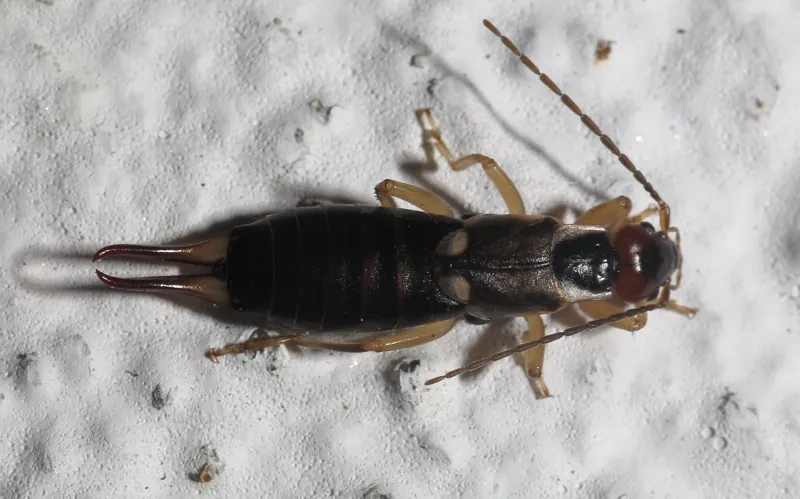
Photo: Luis Miguel Bugallo Sánchez · Wikimedia Commons · CC BY-SA 3.0
At a glance
- Size: about 1.5 to 2 cm as an adult, with a long, flat body.
- Appearance: shiny reddish-brown, two pincers (cerci) at the tip of the abdomen, larger and curved in males.
- Where: cool, dark, damp places; it comes into houses mostly from June or July.
- Danger: none to your health. It can pinch the skin, but it isn’t venomous and doesn’t crawl into ears.
- Solution: clear and dry out the area around the foundation, seal openings, then treat the perimeter if needed.
How to recognize it
The common European earwig (Forficula auricularia) is the most abundant of the five earwig species known in Quebec. Adults measure about 1.5 to 2 cm. The body is long, flat and covered with a hard, shiny shell, brown to reddish. The antennae are about half the length of the body.
The telltale sign is the two pincers at the tip of the abdomen. In males, they’re large and curved; in females, they’re smaller and almost straight. These pincers are used for courtship, mating and defence. Earwigs have wings folded under short wing covers, but they rarely fly. When crushed, they give off an unpleasant odour.
| Criterion | Earwig | Silverfish | woodlouse |
|---|---|---|---|
| Group | Insect | Insect | Land crustacean |
| Color | Shiny reddish-brown | Silvery grey, scales | Dark grey to slate grey |
| Rear of the body | Two pincers | Three long filaments | Rounded, no pincers |
| Legs | Three pairs | Three pairs | Seven pairs |
See also the guides on woodlice and millipedes and house centipedes, or the page on moisture bugs.
Where is it found in a Montreal home?
Earwigs are nocturnal, partly because they need high humidity to survive. During the day, they hide in cool, dark, damp places: under stones, in garden debris and mulch, in wooden fences, the hollow legs of patio furniture, hollow aluminum doors and cracks. They come out at dusk.
They start coming into houses from June or July, by accident. Humid summers favour them. Indoors, they’re mostly found near water sources: around sinks, the bathtub and the shower, in the laundry room, the basement and the garage. They also slip into door and window frames, or arrive hidden in a bouquet of cut flowers.
Adults spend the winter in the soil. Unusually for an insect, the female guards her eggs, cleans them and protects her young during their first stages.
Is it dangerous?
No. Despite its name, the earwig doesn’t crawl into ears: it’s an old European superstition. It isn’t venomous, doesn’t sting and doesn’t transmit any disease. If handled, it may pinch the skin with its cerci, without any consequences.
The real problem is the nuisance: you find them in food, clothes, bedding or laundry. In the garden, they’re often helpful, because they eat decaying matter, aphids, insect larvae and slug eggs. When they’re very numerous, though, they can nibble on young shoots, leaves and flowers.
How to get rid of it
Earwigs come from outside: it all comes down to what’s around the foundation.
- Create a dry strip around the house: remove mulch, dead leaves, grass clippings, boards and stones lying against the foundation.
- Deal with water: fix leaks, dripping outdoor faucets and downspouts that soak the ground near the wall.
- Trim vegetation that’s too close to the house so air and light can dry out the soil.
- Seal: foundation cracks, bottoms of doors, window frames and damaged screens.
- Indoors: pick them up with a tissue or vacuum them up, without crushing them, and use a dehumidifier in the basement.
- Traps: a rolled-up piece of corrugated cardboard, set out in the garden in the evening, can be emptied into soapy water in the morning.
Diatomaceous earth is a fine powder made from crushed microscopic marine fossils. According to Health Canada, it stays effective as long as it’s dry and it isn’t toxic to humans and animals, but you should avoid breathing in the dust. As with any product, choose one that carries a Health Canada registration number and follow the label.
A professional starts with an inspection before any treatment to find damp areas and entry points. If there are a lot of earwigs, they treat the outside perimeter and cracks with products (biopesticides and pesticides) registered by Health Canada, applied according to the label, alongside the moisture fixes.
When to call an exterminator
A few earwigs each summer is normal. Call if you find them every day in several rooms, in your bedding or food, or if the problem comes back despite cleaning up around the foundation. It’s often a sign of excess moisture that also attracts other critters, such as Silverfish.
Extermi Pro holds permits from the Quebec Ministry of the Environment and the City of Montreal. Our certified technicians travel in unmarked vehicles, and the work is covered by a written guarantee. Contact us for a free quote, or browse our other guides to Insect identification.
Frequently Asked Questions
Do earwigs really crawl into ears?
No. It’s a legend from Europe. Earwigs look for dark, damp hiding spots, like cracks or folds of fabric, not the human body.
Do earwigs sting or bite?
They don’t sting and aren’t venomous. If you pick one up, it may pinch your skin with its cerci, but it’s harmless.
Why are there earwigs in my bathroom?
Because they need moisture. They’re attracted to drains, the bathtub, the shower and leaks. They mostly come in during the summer, when the ground around the house is damp and cluttered with mulch or debris.
Does diatomaceous earth work against earwigs?
Health Canada lists it as an option against earwigs: it works as long as it stays dry. It doesn’t replace cleaning up around the foundation, which remains the most effective measure.
Seeing this insect in your home? Our certified technicians serve Montreal, Laval, the North Shore and the South Shore, 24 hours a day. Request a free quote or call (438) 835-8401.
Other identification guides: Moisture Bugs: Identifying Basement Insects · Millipedes and House Centipedes: Identification and Solutions · Woodlice in the House: Identification and Solutions · Larder Beetles and Carpet Beetles: How to Recognize Them · Weevils and Flour Beetles in the Pantry · Wolf Spiders and House Spiders: Identification and Danger · Deer Mouse, House Mouse or Rat: How to Tell Them Apart · Biting Midges: Recognizing These Tiny Biting Insects · all the guides