
In Quebec, the "brûlot" is a tiny biting insect of the family Ceratopogonidae, known in English as a no-see-um or biting midge. You feel it before you see it: its bite feels like a burn, hence its French name. It's born outdoors, in wetlands. It can't be eliminated like an insect that lives in the house, but you can reduce bites.
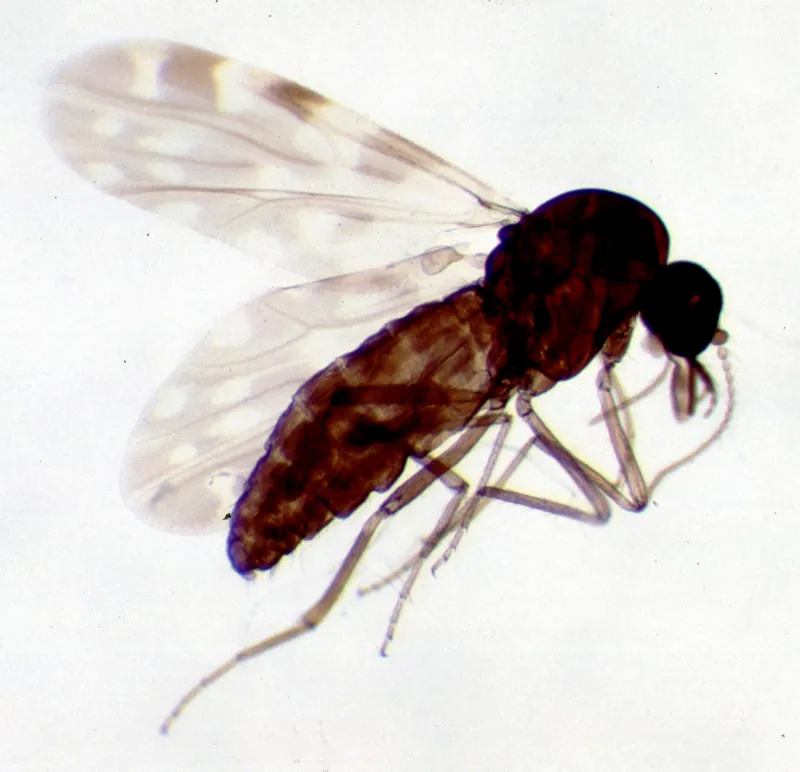
Photo: Daktaridudu · Wikimedia Commons · CC BY-SA 4.0
At a glance
- Size: about 1 to 2 mm, so small you barely notice it.
- Only the female bites: she needs blood to produce her eggs.
- Its larvae live in mud, waterlogged soil and damp vegetation, along lakes, rivers, marshes and ditches.
- It bites mostly in summer, at dawn, at dusk and in the evening.
- Solution: protect yourself and limit waterlogged areas around the house. No treatment can wipe out biting midges from an area.
How to recognize it
The adult biting midge usually measures 1 to 2 mm. What you notice most is its sharp bite, like a small burn, followed by itching.
The male feeds on nectar. The female takes a blood meal to develop her eggs, then lays them in dark, wet places rich in organic matter. The larvae live in mud, waterlogged soil or damp plant debris.
It gets through ordinary window screens, so you get bitten indoors, near an open window, without seeing anything come in.
| Insect | What you notice | Where it lives |
|---|---|---|
| Biting midge | Barely visible; burning bite, often at dusk; gets through ordinary screens | Outdoors, near water and waterlogged soil |
| Mosquito | Much bigger, long legs, easy to see | Outdoors, standing water |
| Puce | Jumps; bites often clustered on the ankles and legs | In the house, often with a cat or dog |
| Punaise de lit | Bites discovered on waking up, in a line or a cluster | In the house, mainly the bed and furniture |
Where is it found in a Montreal home?
In fact, the biting midge doesn't live in the house. It breeds outdoors: along the shores of the Saint-Laurent, the Rivière des Prairies and the Rivière des Mille Îles, creek banks, marshes, poorly drained parks and damp wooded areas. You mostly come across it in summer, on the patio, the balcony or near the cottage, at dawn and in the evening.
Around a house, it takes advantage of spots that stay wet: an overwatered lawn, a poorly drained corner, muddy ground at the foot of a downspout. It then comes in through ordinary screens. According to the University of Arizona, the waterlogged soil of a houseplant can even serve as an egg-laying site.
Is it dangerous?
For most people, it's mainly a nuisance. The bite leaves a small red bump, sometimes a small blister, that itches intensely. Scratching can break the skin and lead to infection. Some people have stronger, longer-lasting reactions. If a reaction worries you, call Info-Santé 811 or see a health professional.
In North America, university sources mainly link biting midges to diseases in livestock and deer, such as bluetongue. In other parts of the world, some species transmit diseases to humans.
How to get rid of it
Let's be honest: you can't make biting midges disappear from a neighbourhood, a shoreline or a wooded area. Their source is too vast. In a study cited by the University of Florida, even eliminating a known breeding site didn't change the number of adults. Here's what really helps:
- Protect yourself. Wear long, light-coloured clothing at dusk. A fine-mesh net over a hat helps in the woods or at the cottage.
- Use an insect repellent registered by Health Canada, following the label.
- Change your screens. Ordinary screens let biting midges through. Screens with much finer mesh, properly installed and free of holes, make a real difference.
- Dry out the area around the house. Water less, fix poorly drained areas and direct downspout water away from the foundation. When the soil dries out, the eggs and larvae die.
- Let houseplant soil dry out between waterings.
What can an exterminator do? First, confirm what's biting you: bites blamed on biting midges sometimes come from fleas or bed bugs, which live in the house and can be treated. The technician inspects before any treatment and advises you on screens, drainage and entry points. In some cases, a targeted treatment of surfaces around the house may be considered, with products registered by Health Canada, applied according to the label. Its effect is limited and temporary, and it doesn't address the source. If it isn't appropriate, we'll tell you.
When to call an exterminator
Call if you're getting bitten indoors without seeing any insect, especially at night, in bed, or outside of summer. That pattern looks more like bed bugs or fleas than biting midges, and those insects can be eliminated. For advice about your property or your openings, go to our page: contact. See also the other guides in the library Insect identification.
Frequently Asked Questions
Can biting midges live in my house?
No, they develop outdoors, in mud and waterlogged soil. They come in through windows and bite, but they don't form a colony in the house the way bed bugs do. The only exception: the very wet soil of a houseplant can serve as an egg-laying site.
Can an exterminator get rid of the biting midges on my property?
No. They come from wetlands in the area, often well beyond your property. A professional can confirm the insect, give you advice and, only if appropriate, treat certain surfaces around the house, with an effect that's limited in time.
I'm getting bitten at night in the middle of winter: is it a biting midge?
That's very unlikely. Biting midges are active outdoors during the warm season. Bites in winter, in bed, point more to bed bugs or fleas. An inspection can confirm it.
Do biting midges transmit disease?
In North America, they're mainly known for transmitting diseases to livestock. For humans, the main problem is the bite itself and the itching, which can be intense in sensitive people.
Seeing this insect in your home? Our certified technicians serve Montreal, Laval, the North Shore and the South Shore, 24 hours a day. Request a free quote or call (438) 835-8401.
Other identification guides: Moisture Bugs: Identifying Basement Insects · Earwigs: Identification and Solutions in Montreal · Millipedes and House Centipedes: Identification and Solutions · Woodlice in the House: Identification and Solutions · Larder Beetles and Carpet Beetles: How to Recognize Them · Weevils and Flour Beetles in the Pantry · Wolf Spiders and House Spiders: Identification and Danger · Deer Mouse, House Mouse or Rat: How to Tell Them Apart · all the guides