
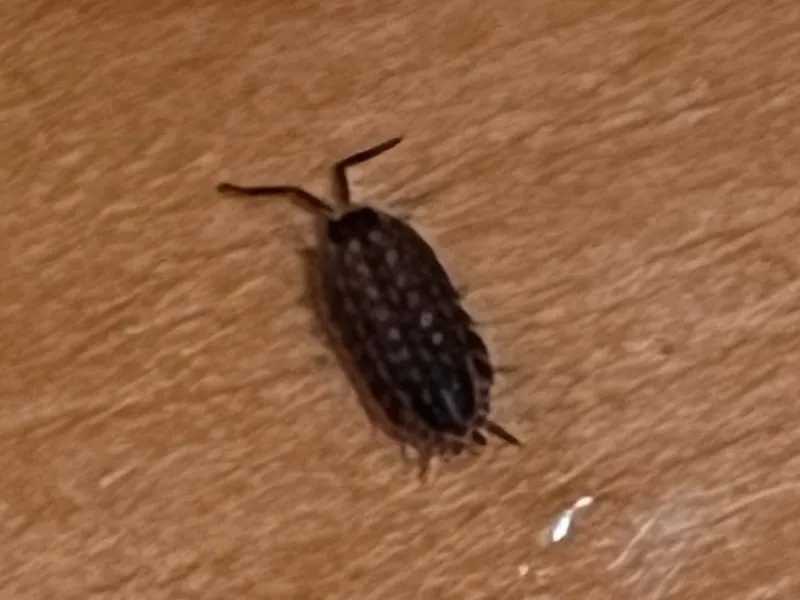
The woodlouse is the small grey, oval, domed critter you find in the basement, near a door or under a planter. It's not an insect but a land crustacean, a distant relative of lobsters and shrimp. It's harmless, but it needs a lot of moisture: if it settles into your Montreal home, it's first and foremost a sign of a moisture problem to fix.
At a glance
- Size: less than 2 cm, with an oval, domed body made of overlapping plates.
- Colour: dark grey to slate grey; seven pairs of legs.
- Where: basement, crawl space, ground floor, near doors and damp foundations.
- Danger: none. It doesn't bite or sting and doesn't transmit disease.
- Solution: reduce humidity, clear the area around the foundation and caulk; indoor insecticides are of little use.
How to recognize it
The woodlouse belongs to the isopods, a group of crustaceans adapted to life on land. It measures less than 2 cm. Its oval body is domed on top and flat underneath, covered with hard overlapping plates like a small suit of armour. It is dark grey to slate grey, with seven pairs of legs and two clearly visible antennae.
Two kinds are found in homes. The pill bug, often called a roly-poly, can roll up completely into a ball. The woodlouse proper doesn't roll up and has two small tail-like appendages at the back. Rolling into a ball isn't just a defence: it also helps the animal hold on to its water.
The female carries her eggs, then her young, in a pouch under her belly. The young look like smaller versions of the adults and can live for a few years.
| Criterion | woodlouse | Millipede (diplopod) | Silverfish |
|---|---|---|---|
| Group | Land crustacean | Diplopod | Insect |
| Shape | Oval, domed | Long and cylindrical | Spindle-shaped, flattened |
| Legs | Seven pairs | Two pairs per segment | Three pairs |
| Rear of the body | Rounded or two small appendages | Rounded | Three long filaments |
| Reaction | Freezes or rolls up | Rolls up | Runs away quickly |
For other critters that like damp places, see the guides on millipedes and house centipedes and earwigs, or the page on moisture bugs.
Where is it found in a Montreal home?
Outdoors, the woodlouse lives under stones, boards, mulch and dead leaves, and in rotting wood. It is mostly active at night. It eats decaying plant matter and fungi, which makes it a useful recycler in the garden.
It comes into the house when it's looking for water, or when the soil around the foundation is soaked. It's mostly seen in the basement, in the crawl space, on the ground floor, and near exterior doors and basement windows. Foundations surrounded by mulch, planters or dense vegetation are the most affected.
Indoors, the air is usually too dry for it: it dies quickly. If you see them often, and alive, it means they're finding abnormal moisture in your home (a leak, infiltration, condensation, damp wood) or a poorly sealed opening under a door or around a window.
Is it dangerous?
No. The woodlouse doesn't bite or sting and doesn't transmit any disease. It's harmless to children and pets, and it doesn't damage food, clothing or sound wood. In the garden, it can sometimes nibble on seedlings or soft fruit lying on the ground.
What you should take seriously is what it reveals: a damp basement, water infiltration or rotting wood. These conditions also attract other pests, such as silverfish, and can damage the house over time.
How to get rid of it
Since the woodlouse depends on moisture, drying things out is how you get rid of it.
- Clear the foundation: remove dead leaves, mulch, rotting wood, stones, boards and pots up against the wall.
- Manage water: grade the lot away from the house, extend downspouts away from it and fix leaks.
- Dry out the inside: a dehumidifier or fan in the basement, crawl space ventilation.
- Seal entry points: weatherstripping under doors, caulking around windows and foundation cracks, ideally before fall.
- Indoors: pick them up, or sweep or vacuum them, then toss them outside.
Indoor insecticides are of little use against woodlice, and Health Canada generally doesn't recommend them, since these animals quickly die of dehydration in the house. No treatment will solve anything as long as the source of moisture is still there.
A professional inspects before any treatment: they look for the source of moisture, entry points and other pests drawn by the same conditions. If the population is large, they may treat the outside perimeter with products (biopesticides and pesticides) registered by Health Canada, applied according to the label, once the debris has been removed.
When to call an exterminator
A few dead woodlice in spring or fall are nothing to worry about. Call if you see live ones every day, in several rooms, or along with other moisture-loving pests such as Silverfish, house centipedes or earwigs.
Extermi Pro holds permits from Quebec's Ministry of the Environment and the City of Montreal. Our certified technicians arrive in unmarked vehicles, and the work is covered by a written guarantee. Contact us for a free quote, or browse our guides to Insect identification.
Frequently Asked Questions
Is a woodlouse an insect?
No. It's a land crustacean from the isopod family, related to lobsters and shrimp. It has seven pairs of legs, while an insect has three.
What does it mean when there are woodlice in the house?
Most often, excess moisture: a leak, water infiltration, a poorly ventilated basement or damp wood. It can also point to a poorly sealed opening under a door or around a window.
Are woodlice dangerous?
No. They don't bite or sting and don't transmit disease. They don't eat food or sound wood in the house.
What's the difference between a woodlouse and a pill bug?
The pill bug, also called a roly-poly, can roll up completely into a ball. The woodlouse proper doesn't roll up and has two small appendages at the back of its body.
Is an insecticide enough to get rid of woodlice?
No. Indoor insecticides are of little use, because woodlice already die from the dry air inside. You first need to fix the moisture problem and clear the area around the foundation.
Seeing this insect in your home? Our certified technicians serve Montreal, Laval, the North Shore and the South Shore, 24 hours a day. Request a free quote or call (438) 835-8401.
Other identification guides: Moisture Bugs: Identifying Basement Insects · Earwigs: Identification and Solutions in Montreal · Millipedes and House Centipedes: Identification and Solutions · Larder Beetles and Carpet Beetles: How to Recognize Them · Weevils and Flour Beetles in the Pantry · Wolf Spiders and House Spiders: Identification and Danger · Deer Mouse, House Mouse or Rat: How to Tell Them Apart · Biting Midges: Recognizing These Tiny Biting Insects · all the guides