
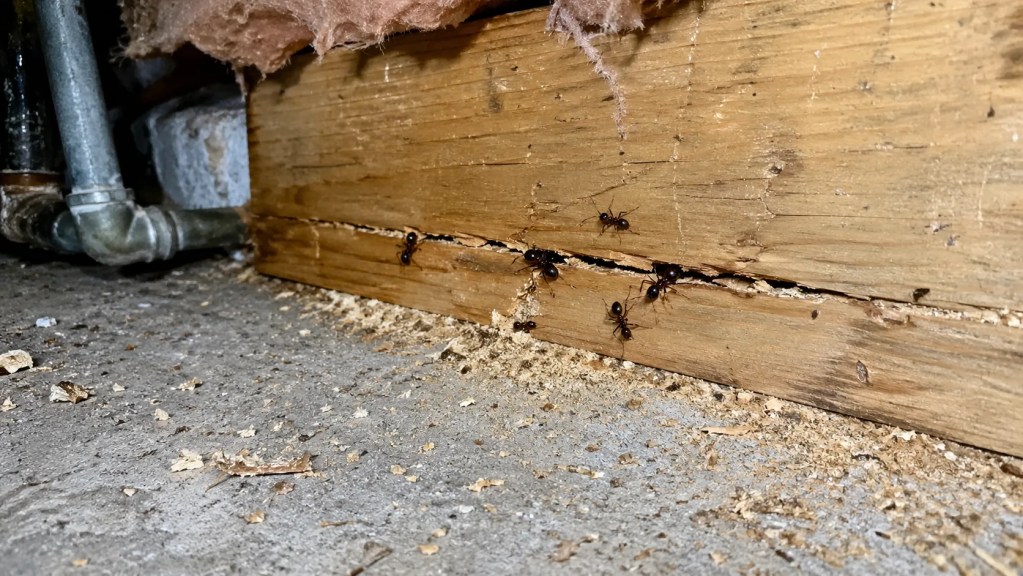
Each year, starting in late May, homeowners in the Saint-Laurent area notice winged ants emerging from their basement floors or foundation window frames. This phenomenon — the’Carpenter ant swarming in the basement — is not a mere seasonal inconvenience: it is the most visible alarm signal of a colony already established within the structural wood of your residence. In Saint-Laurent, where the real estate stock mixes 1960s bungalows, brick duplexes and apartment buildings with solid wood joists, conditions are particularly favorable for the discreet installation of Black carpenter ant, the black carpenter ant of North America.
Structural inspection of the basement is the decisive step that many homeowners postpone, often until damage to beams, joists, or foundation components becomes costly to repair. Knowing where to look, what clues to read in the wood, and how to distinguish an active infestation from an old abandoned nest makes all the difference between targeted intervention and major renovation work. This article guides you through each step of the inspection, taking into account the specific construction features of houses in Saint-Laurent.
Key takeaways about carpenter ants in the basement in Saint-Laurent
- May swarming is direct proof that a mature colony (3 to 6 years old) is already housed within the structural wood of your basement.
- Carpenter ants excavate clean galleries in wet or rotten wood of beams, joists, and sill plates—they do not eat the wood, they excavate it.
- The main diagnostic clue is coarse sawdust (frass) mixed with insect fragments, deposited in small piles under beams or near foundation cracks.
- In Saint-Laurent, the priority areas for inspection are: the bearing surface of concrete foundations, rim joists, load-bearing beams near water entries, and basement window frames.
- A professional intervention combining residual powder treatment and bait gel is necessary to eliminate the mother colony; over-the-counter insecticides do not reach the internal galleries.
What is the’Carpenter ant swarming And why does it happen in the basement in May in Saint-Laurent?
Swarming is the reproductive phase of the carpenter ant life cycle. Between late April and mid-June — with a usual peak around the third week of May in the Montreal metropolitan area — mature colonies produce winged individuals, called fleas, whose mission is to leave the nest, mate in flight, and establish new colonies. What you are observing in your basement are these reproductive ants looking for an exit to the outside.
Several factors explain why this phenomenon occurs specifically in basements rather than on the ground floor or in attics. Firstly, carpenter ant colonies prefer wood with moisture content exceeding 15% %— a common condition in the foundation joists of homes in Saint-Laurent built before 1980, where the waterproofing of footings and foundation walls is often inadequate. Secondly, the galleries are dug where the wood is most accessible: sill plates laid directly on concrete, rim joists in contact with the ground or residual moisture, and load-bearing beams penetrated by plumbing pipes.
It is important to distinguish winged ants from winged termites, a common confusion. Winged carpenter ants exhibit:
- Unequal size of the two pairs of wings (forewings larger than hindwings)
- A body size between 15 and 20 mm for queens
- A slender waist pinched between the thorax and the abdomen
- Elbow antennas (bent at 90 degrees)
- A uniform black coloration, sometimes with reddish reflections on the thorax
The presence of swarms inside the basement—as opposed to winged ants simply entering through a foundation crack from outside—confirms that the nest is established inside the structure. A swarming colony generally has between three and six years of existence, meaning structural damage has already been occurring for several seasons.
How to make a Structural survey of the basement to detect a carpenter ant infestation?
A rigorous diagnosis of the basement follows a precise methodology, from general to specific. Before touching anything, equip yourself with a powerful flashlight, a sturdy flathead screwdriver, a light hammer, and ideally, a probe hygrometer to measure the moisture content of the wood. Here are the steps to follow:
- Visual inspection of the seat rails: Start with the piece of lumber laid directly on top of the foundation wall. Look for discolored, gray, or blackish areas that indicate fungal decay—the sign that moisture has weakened the wood and made the spot attractive to ants. Run your screwdriver along the wood: if the blade sinks in easily without resistance, the wood is compromised.
- Frass (gallery sawdust) search: Inspect the basement floor, the horizontal surfaces of the joists, and the corners near the foundation walls. Carpenter ant frass resembles coarse sawdust mixed with small, frayed wood fragments and sometimes dead insect parts. Its texture is coarser than regular sawdust, and it forms characteristic small piles.
- Sound test of joists and beams Gently tap the load-bearing beams with your hammer. A hollow sound—distinct from the dull thud of healthy wood—reveals internal galleries. Carpenter ants carve perfectly smooth tunnels, unlike termites that leave behind fibrous wood.
- Moisture Area Inspection: Identify all sources of moisture: plumbing pipes with condensation, cracked foundation with water infiltration, clogged floor drains, poorly sealed basement windows. These areas are the preferred entry points and the most likely nesting sites.
- Service pass verification: Holes drilled in joists for the passage of pipes, electrical cables, or ventilation ducts are pathways between different floors. A colony may have a satellite nest in the basement and a main colony in an exterior wall or under an adjacent deck.
In Saint-Laurent, special attention should be paid to houses where the basement has been partially finished (drywall on the walls, suspended drop ceilings), as the areas hidden behind these materials are difficult to access but often the most affected. In such cases, a pest control professional will use an endoscope or infrared moisture detectors to inspect without demolition.
What damage the Do carpenter ants cause damage to beams and the structure? from a basement?
Contrary to a persistent misconception, carpenter ants do not feed on wood. They excavate it to create their nesting galleries, expelling wood shavings outside the nest—hence the formation of characteristic piles of frass. This distinction is important: the damage is mechanical rather than nutritional, but its structural impact can be just as severe as that of termites, particularly when the infestation is long-standing and the wood was already weakened by moisture.
Here are the types of damage observed according to the affected wood parts:
- Seat cushion The cornerstone of the anchoring between the wooden structure and the foundation. When dug out over a significant length, it loses its load-bearing capacity and can lead to a progressive settling of the ground floor, visible by sticking doors or bouncy floors.
- Floor joists Horizontal openings in joists reduce their load-bearing cross-section. A joist with a cavity exceeding 30 % of its cross-section is considered structurally compromised according to wood construction standards.
- Solid hardwood beams These elements are particularly vulnerable in older homes where the wood has not been treated against insects. The galleries can extend a meter or more inside a beam, with no apparent external signs until pressure causes a sudden break.
- Foundation window frames: In direct contact with the outside ground and exposed to humidity variations, these frames are often the first sites of nesting. Damage here is generally less severe structurally, but it provides an entry point to adjacent load-bearing elements.
- Joists and beams in a finished basement: These secondary areas, often overlooked during inspections, can house satellite nests that feed and protect the mother colony nestled in a main beam.
An often underestimated aspect is the coexistence of fungal decay and ant infestation. Brown or white rot fungi first weaken the wood, lower its density, and create ideal moisture conditions. Carpenter ants then exploit this weakened wood, considerably accelerating deterioration. In the most advanced cases observed in unheated and poorly ventilated basements in Saint-Laurent, entire beams can be reduced to an apparently intact outer shell that is completely hollowed out inside. Only a sounding test or a professional inspection can detect this condition before structural failure occurs.
How to distinguish a active carpenter ant infestation from an old abandoned nest in the rafters?
This distinction is fundamental to avoid either unnecessary treatment or the neglect of a still-active colony. Several indicators clearly differentiate an active infestation from an abandoned nest:
- Frass freshness: Fresh frass is light in color, almost white or cream, and has a slightly damp texture to the touch. Old frass is grayish, compacted, and may show signs of mold. If you find light-colored frass underneath a beam, the colony is likely active.
- Presence of live workers: During the active season (May to September), workers are mostly visible at night. An inspection with a flashlight after 10 PM in an unlit basement often reveals workers moving along beams or walls. The complete absence of live individuals during the active season is a sign that the nest may be abandoned or that the colony has migrated.
- Scratching sounds in the wood: An active colony produces a faint scratching or crackling noise in the wood, particularly audible when pressing an ear against a beam in a quiet basement. This noise is produced by the workers' mandibles as they continue to enlarge the galleries.
- Presence of brood If you manage to open a section of suspect wood, the presence of translucent white larvae, pupae, and eggs confirms an active colony. An abandoned nest will be empty, with dry and clean galleries.
- Gallery Freshness: The galleries of an active nest have smooth, slightly shiny walls. Abandoned galleries are dull, sometimes covered with a thin layer of dust or mold.
A particular case deserves attention: satellite nests. A carpenter ant colony can simultaneously maintain a mother colony outside the house (in a tree stump, under a wooden deck, or in a pile of firewood stored against the wall) and several satellite nests inside, connected by scent trails. In this scenario, you may observe ants active in the basement without finding the main nest inside. Treating only the satellite nests without addressing the outdoor mother colony is ineffective; recolonization usually occurs within a few weeks.
For Saint-Laurent homeowners whose backyards include mature trees—maples, ash, elm—or whose decks are built with untreated wood directly on the ground, inspecting the exterior is as important as inspecting the basement. City of Montreal reminds on its official website Carpenter ants are native insects that play an ecological role in the decomposition of dead wood, but they become problematic when they infest inhabited structures.
What are the professional intervention methods to eliminate Carpenter ants in the basement without further damaging the structure?
The effective elimination of a carpenter ant infestation in the basement relies on a multi-pronged strategy, tailored to the structural condition of the wood, the location of the galleries, and the presence or absence of satellite nests. Over-the-counter approaches – insecticide sprays, foggers, sticky traps – do not reach the interior of the galleries and do not eliminate the queen, the only individual capable of perpetuating the colony.
Here are the methods used by professional exterminators, in increasing order of intensity:
- Direct injection insecticide powder treatment: Diatomite-based powders or wettable powder deltamethrin are injected directly into identified galleries through small drill holes (3 to 5 mm in diameter) made in the wood. The powder adheres to the ants' exoskeletons and is transported to the queen through mutual contact and grooming. This method is most effective for nests well-located in accessible beams.
- Application of bait gel (borates or fipronil): Gel baits are placed on traffic routes identified during inspection. Worker ants transport the bait to the main colony, ensuring the active ingredient is spread throughout the social structure. This method is particularly well-suited for satellite nests where the exact location is difficult to determine.
- Peripheral spray treatment: A residual insecticide application (bifenthrin or lambda-cyhalothrin) is performed along the exterior foundations, doorways, and window frames. This treatment creates a chemical barrier that interrupts scent trails connecting exterior satellite nests to interior galleries.
- Preventive treatment of structural wood: In cases where timber is accessible and not yet severely degraded, a surface treatment of sodium borate (Tim-bor or equivalent) can be applied to the sill plates and rim joists. This treatment penetrates the wood, making it toxic to wood-boring insects and inhibiting the development of decay fungi.
A critical aspect often overlooked is correcting conditions that favor infestation. Even after successful treatment, a basement where the relative humidity regularly exceeds 60 %, where sill plates are in direct contact with damp concrete without a vapor barrier, or where construction debris is stored against walls will eventually be re-colonized. Recommended complementary measures include:
- Installation or verification of proper operation of a dehumidifier in the basement (objective: relative humidity below 50 %)
- Replacement of rotten seat stringers with pressure-treated wood (CCA or ACQ) with a capillary membrane between the wood and concrete.
- Removal of firewood piles, vegetative debris, and tree stumps within a five-meter radius of the foundation
- Sealing of foundation cracks and waterproofing of service penetrations with fire-retardant polyurethane foam
- Size of tree branches touching or overhanging the roof, serving as a natural bridge to the structure
In homes in Saint-Laurent where the basement has been finished with drywall, an annual inspection by a professional is strongly recommended, particularly between May and June during the swarming season. Early detection, before the colony reaches its reproductive maturity, remains the most effective way to limit both structural damage and the extent of the extermination work required.
And in the neighboring neighborhoods?
- Ahuntsic-Cartierville — For targeted advice on this neighboring district, consult our local service page.
- Mount Royal — For targeted advice on this neighboring district, consult our local service page.
- Côte-des-Neiges — For targeted advice on this neighboring district, consult our local service page.
- Parc-Extension — For targeted advice on this neighboring district, consult our local service page.
- Pierrefonds-Roxboro — For targeted advice on this neighboring district, consult our local service page.