
The bed bug bites often go unnoticed during the night, then show up when you wake as small, itchy red marks. Montreal, with its century-old triplexes, high-density condos and apartments in Plateau-Mont-Royal where leases turn over quickly, offers ideal conditions for the spread of Bed bug. Recognizing these bites as early as possible means acting before the infestation settles in for good.
The problem: several insects bite at night. Mosquitoes, fleas, chiggers — there are many suspects, and the marks look alike. Yet the characteristic bed bug pattern stands out. Lined up in a row. Tight clusters. Specific areas of the body exposed outside the sheets. This guide untangles the signs, explains how long they take to appear and shows you how to confirm the insect's presence with a thorough mattress inspection.
- Line or cluster pattern: three to five bites lined up or grouped on the same patch of skin are the hallmark of Bed bug, often described as “breakfast, lunch and dinner.”
- Variable onset time: marks can appear as early as the next morning or only after two to three days, depending on the person's immune sensitivity.
- Exposed areas targeted: neck, shoulders, arms, chest and ankles — any skin that sticks out from under the covers during sleep.
- A significant proportion of people do not react: no itching does not mean no bed bugs; a physical inspection of the mattress remains essential.
- Confirmation by inspection: rust-coloured stains on the seams, black spots (droppings), translucent shed skins and, sometimes, a faint smell of rancid coriander indicate an active infestation.
What do they look like? bed bug bites sur la peau ?
Bed bug bites appear as small, slightly raised red papules, often surrounded by a pinkish halo, characterized by their grouping in a straight line or a tight cluster, their location on exposed skin and the persistent itching they cause.

The line pattern — three evenly spaced bites — reflects the insect's feeding behaviour: the bed bug bites, moves forward slightly, and bites again if the vein is not accessible. This movement produces the classic alignment. In clusters, the marks indicate several bugs feeding at the same time on the same area, which happens in more advanced infestations.
The size of each mark can vary, sometimes reaching several centimetres depending on the immune reaction. The centre may show a small, darker red dot — the injection site. Some people develop a larger, almost hive-like reaction with noticeable swelling. Others get tiny blisters filled with clear fluid. It all depends on the individual immune response, which can also change over time: a person who is not very sensitive at first can develop increasingly pronounced reactions after repeated exposure.
Bed bug bites generally do not burn when they happen. The bed bug injects a local anaesthetic and an anticoagulant before feeding — you are asleep, you feel nothing. It is in the morning that the itching sets in, sometimes intense, sometimes mild, sometimes absent. Scratching makes things worse: an open sore can become infected. If the marks ooze or are surrounded by spreading redness, see a doctor.
Which areas of the body are targeted, and why does the pattern de piqûres nocturnes follow a precise layout?
Bed bugs target only bare skin exposed during sleep, guided by body heat and exhaled carbon dioxide, which explains why the marks are concentrated on the arms, neck, shoulders, chest and ankles rather than on areas covered by pyjamas.
In summer, when you sleep wearing very little in an apartment in Mile-End or Rosemont, the exposed surface is large — bites are spread over wide areas. In the fall, as nights get cooler and people cover up more, the marks concentrate on the hands, forearms and face, the only parts that stick out from the covers. October, for example, is often the month when tenants notice bites on hands they used to keep covered.
Bed bugs detect exhaled carbon dioxide from several metres away, but their detection of body heat is limited to a few centimetres. They travel across the floor or the box spring to reach the bed. Once nearby, they look for the most accessible vascular area: neck, wrist, inner ankle, crook of the elbow. They avoid hairy areas such as the scalp — unlike lice — and do not venture under clothing worn tight against the skin.
Understanding this pattern helps distinguish a bed bug infestation from another cause. If the marks appear under pyjamas, under an elastic waistband or between the toes, look for another culprit. A dermatologist or family doctor can point you in the right direction, but confirmation is always entomological: you have to find the insect or its traces.
How to tell a bed bug bite from a mosquito, flea or mite bite ?
A bed bug bite differs from a mosquito bite by its grouped pattern and its location limited to areas exposed during sleep; it differs from a flea bite by its larger size and the absence of a marked central entry point; it differs from a reaction to dust mites by the presence of distinct, individual skin lesions rather than diffuse irritation.
| Features | Punaise de lit | Moustique | Puce |
|---|---|---|---|
| Pattern | Line or cluster of 3 to 5 marks | Isolated, random marks | Low clusters, often on the feet and ankles |
| Zones typiques | Neck, arms, shoulders, chest | All exposed areas, even in the evening | Feet, ankles, calves, lower back |
| Moment d’apparition | On waking (night only) | At any time, especially at dusk | Day and night, contact with an animal or the floor |
| Aspect de la marque | Red papule, pinkish halo, sometimes a blister | White then red bump, fades quickly | Small red mark with a central dot, very itchy |
| Insect sighting | Hard to see (nocturnal, hides) | Visible, bourdonne | Visible on the animal or in the bedding |
Contrary to a common belief, fleas are not strictly limited to the ankles. They jump and can reach the waist or lower back, especially if a pet sleeps in the bed. What clearly sets them apart is the presence of an infested animal in the home, and the visibility of the insect — tiny, shiny brown and fast-moving.
Mosquitoes, for their part, bite anytime and anywhere, from wrist to calf. Their marks swell and disappear within a few hours. Bed bug bites last several days, even a week, and start again every night as long as the insect has not been eliminated. This nightly recurrence is the strongest indicator.
How long after the bite do bed bug symptoms apparaissent-ils ?
Symptoms of a bed bug bite appear within a time frame ranging from a few hours to several days depending on individual sensitivity — a first exposure rarely produces an immediate reaction, while repeated exposures trigger increasingly fast and intense responses.
On first contact, the immune system has not yet developed a response to the antigens in bed bug saliva. Result: no marks, no itching. This first silent phase sometimes lasts for weeks. That is why people living in an apartment in Vieux-Rosemont or Côte-des-Neiges can host an infestation for months without knowing it.
After sensitization, the delay gets shorter. The marks appear the next morning, then, after several months of exposure, sometimes in less than an hour. The reaction can progress to hypersensitivity: widespread swelling, hives, and in rare cases a systemic reaction requiring urgent medical attention.
Conversely, a significant proportion of people simply never develop any visible reaction, no matter how long they are exposed — estimates vary considerably between studies. These people can contaminate other homes by moving furniture or luggage without ever suspecting they are carrying insects. This is one of the reasons why, according to the City of Montreal's open data on bed bug extermination reports, reports are concentrated in areas with high residential turnover, such as the neighbourhood of Sainte-Marie.
How to inspect your mattress to confirm the presence of bed bugs in Quebec ?
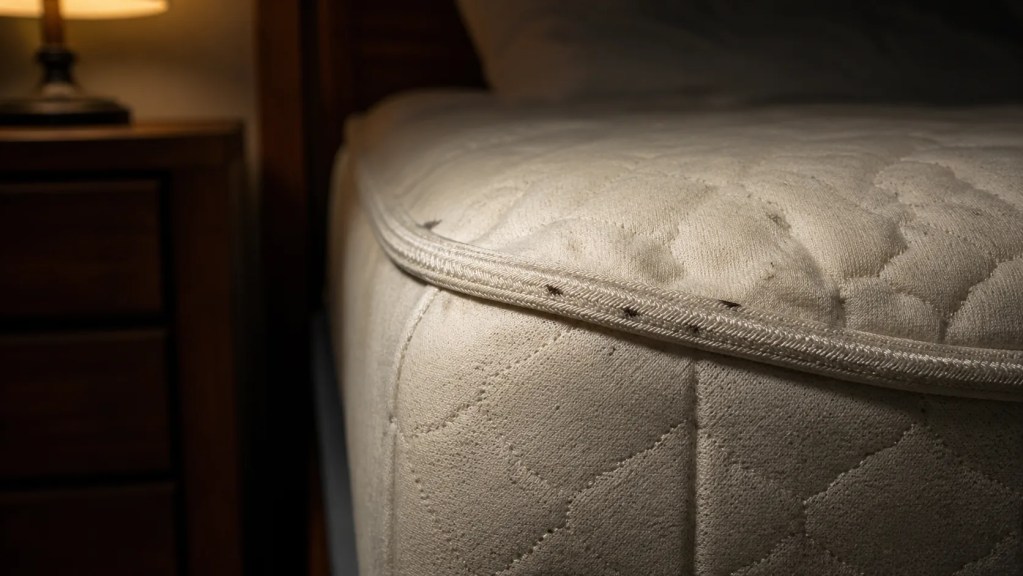
To confirm a bed bug infestation, methodically inspect the seams, folds and underside of the mattress for rust-coloured stains (digested blood), black spots (droppings), pale yellow translucent shed skins and pearly one-millimetre eggs — these four clues together provide reliable entomological evidence.
Here is how to proceed step by step:
- Remove all sheets and bedding, and slide them into a sealed bag to avoid spreading the bugs.
- Examine the mattress seams with a powerful flashlight — focus on the edges and corners, favourite spots of Bed bug.
- Run a piece of cardboard or a credit card along the seams to flush out hidden bugs and shed skins (translucent exuviae).
- Inspectez le sommier, especially the wooden grooves, staples and areas of folded fabric.
- Check the headboard, frame and bed legs — screws, bolts and joints are frequent hiding places.
- Examine the baseboards and electrical outlets near the bed, especially in older homes such as those in Plateau-Mont-Royal or Verdun.
- Notez l’odeur : a dense infestation gives off a slightly sweet, rancid smell, sometimes described as coriander or crushed raspberries — a sign that the colony is established.
If you find clues but no live insects, the infestation may be at an early stage or the bugs may be hiding farther away — behind picture frames, in the corners of a pantry, under loose flooring. A professional inspection is then needed. Companies holding a pest management business permit (category C5 or D5) issued by the MELCCFP are authorized to carry out this inspection and to use registered pesticides, including the targeted biopesticide Aprehend (based on Beauveria bassiana), approved in Canada for bed bug treatment. The company carries out two visits, with the follow-up visit taking place 15 to 20 days after the first.
Under Quebec's legal framework, any pesticide application in a dwelling must be carried out by a CD5 certificate holder, which can be verified in the Quebec government's public register of pesticide permits and certificates. If your landlord is slow to act, the Tribunal administratif du logement (TAL) offers recourse.
And in the neighboring neighborhoods?
- Plateau-Mont-Royal — high density of older housing and high tenant turnover, conditions that favour the spread of bed bugs between adjoining apartments.
- Rosemont–La Petite-Patrie — many century-old triplexes with hardwood floors and loose baseboards, ideal hiding places for Bed bug.
- Villeray — dense residential neighbourhood where second-hand furniture changes hands frequently, the main way bed bugs are introduced into a home.
- Côte-des-Neiges — high student and international mobility creates a constant flow of luggage and bedding that can carry insects from one city to another.
- Verdun — a rapidly changing area where apartment renovations can push latent infestations into adjacent units.