
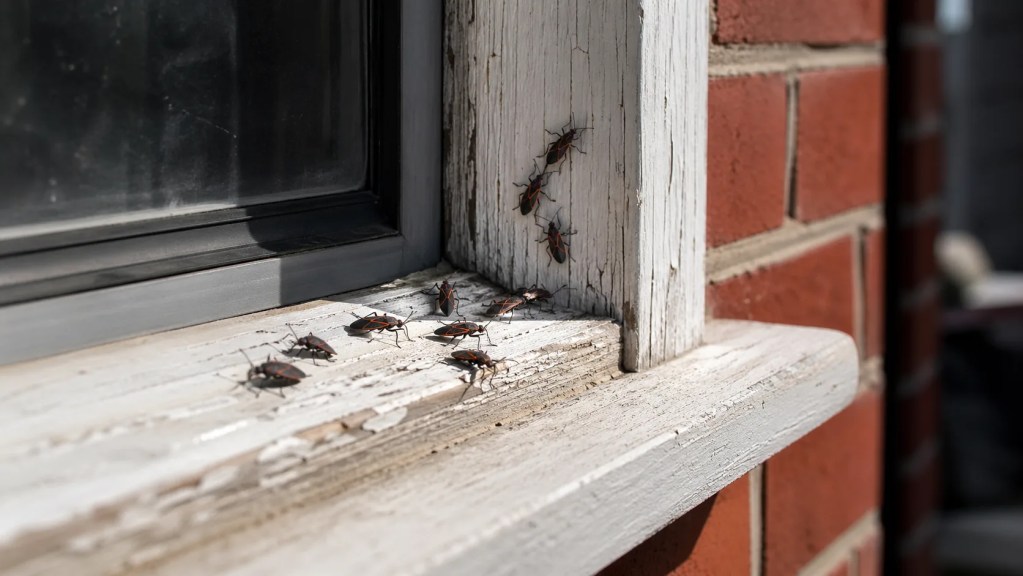
Every June, boxelder bugs around windows in Hochelaga become a topic of conversation in the neighbourhood’s triplexes: these black-and-red insects gather by the dozens on sunny window frames, looking for warmth. Small. Noisy in their own way. Impossible to ignore when they pile up on the white vinyl of a south-facing window frame.
The boxelder bug — Boisea trivittata, also called the maple bug — is not a dangerous species, but a full-blown invasion on a home’s windows can become an obsession within a few days. It is neither rare nor harmless in June in Hochelaga, with the silver maples lining Ontario Street, the neighbourhood’s parks and the warm corridors between rows of duplexes. Understanding its cycle means knowing when and how to act — without wasting effort.
- June is the peak of activity : after the spring hatch, the growing nymphs look for warm surfaces to regulate their body temperature — the south- and west-facing windows of triplexes are their favourite targets.
- Boisea trivittata does not bite or chew : it is a visual and odour nuisance (foul-smelling liquid if crushed), with no direct health risk to residents.
- The source is almost always a silver maple or Manitoba maple nearby : spotting the host tree is the first step to an effective intervention.
- Airtight sealing of window joints remains the most effective preventive action before mid-June.
- A professional perimeter treatment (residual insecticide on exterior frames) can significantly reduce the visible population.
Why do boxelder bugs invade Hochelaga windows specifically in June?
The boxelder bug (Boisea trivittata) is attracted to the warmth radiating from dark, sunny surfaces, with a peak of activity that coincides exactly with the June warm-up in Montreal. Window frames facing south or west on Hochelaga’s dense streets — Adam Street, Sainte-Catherine Street East — build up this warmth and become natural magnets for hundreds of bugs within a few hours.

In May, overwintering adults come out of dormancy and lay eggs on the seed pods and leaves of host maples. June marks the mass hatching of first-generation nymphs: small, bright red and mobile, they immediately climb toward light and warmth. A triplex backing onto a mature silver maple can end up with several hundred bugs on its vinyl frames within a few days.
The Hochelaga neighbourhood combines several aggravating factors: dense cover of silver maples (Acer saccharinum) and Manitoba maples (Acer negundo) in backyards and laneways, and brick façades that store a lot of heat.
Warmth is not the only explanation. These insects communicate through aggregation pheromones: once a few individuals settle on a warm frame, the chemical signal attracts others of their kind. This is what turns a discreet presence into an apparent invasion in sunny weather.
What signs confirm an infestation of boxelder bugs on window frames rather than another insect?
The adult boxelder bug is recognizable by its black colouring with red lines, including three bands on the thorax, its 12–14 mm body and its characteristic acrid, resin-like odour when crushed — distinctive features that clearly set it apart from brown marmorated stink bugs or Asian lady beetles.
Several visual clues can quickly confirm it:
- Clusters on sunny surfaces — vinyl or white-painted wood window frames, roof shingles, south/west-facing brick cladding.
- Bright red nymphs — the young bugs seen in June are entirely red, wingless and measure 3–6 mm. Their presence confirms local breeding.
- Orange-brown fecal spots on frames or screens — a sign that the surface is visited repeatedly.
- Identifiable host trees nearby: silver maple, Manitoba maple, sometimes green ash. In Hochelaga, check the backyards on Joliette Street.
- No structural damage — unlike termites or carpenter ants, Boisea trivittata does not dig any tunnels in wood.
When dozens of red-and-black insects gather on a living-room window frame, check the neighbouring yards: a large silver maple with nymphs visible on its trunk is usually the source. It is the typical June scenario in Hochelaga duplexes.
Not to be confused with the brown marmorated stink bug (Halyomorpha halys), which is wider and marbled brown, with no red bands. It also gives off an odour, but a distinctly different one — closer to cilantro. The two species are often confused, which can lead to the wrong treatment.
Can you control boxelder bugs on windows yourself without professional treatment?
Controlling boxelder bugs on the outside of your home on your own is possible for moderate populations, using three combined actions: mechanical sealing, direct vacuuming and insecticidal soap — but it quickly reaches its limits when the host tree source is large or the bugs get indoors.
Here are the effective DIY steps:
- Vacuum outdoor clusters with a portable vacuum fitted with a disposable bag — empty it outside immediately into a sealed bag. Do not crush them: the foul-smelling liquid stains porous surfaces.
- Spray a diluted Castile soap solution (2 tbsp per litre of water) directly on the insects — kills on contact within minutes, with no lasting toxic residue.
- Seal window joints with silicone or acrylic caulk on cracks, gaps around frames and cable passages. This is the most lasting measure.
- Install intact screens on all open windows — make sure the mesh is taut and free of tears.
- Reduce the pull of warm glass by installing a reflective blind on the inside to lower the warmth the pane radiates outward.
Sealing entry points remains the most cost-effective long-term intervention against insects with aggregation behaviour such as Boisea trivittata, outperforming one-off, untargeted chemical treatments.
When is a professional exterminator needed for boxelder bugs invading the home ?
A professional exterminator becomes necessary when boxelder bugs cross the threshold from the facade to the inside of the home, when the visible population exceeds several hundred individuals, or when repeated sealing attempts fail to stop the intrusions — situations that call for a perimeter treatment with a registered residual insecticide.
A targeted professional treatment for a triplex’s windows generally includes:
- Full exterior perimeter inspection — identification of every possible entry point (frames, foundations, flashing, exterior electrical outlets).
- Residual insecticide application (a product registered in Canada, in an exterior formulation) on the identified gathering surfaces — contact action and residual effect.
- Preventive pruning recommendation if a host maple is too close to the windows — removing branches within 1.5 m of the frames significantly reduces the number of bugs coming in.
- Documented service report that can serve as evidence before the Tribunal administratif du logement (TAL) for rental housing.
In areas of adjoining income properties, such as between Sainte-Catherine Street East and Rosemont Boulevard, a treatment coordinated between neighbouring owners multiplies effectiveness, because Boisea trivittata moves freely from one building to the next. Treating a single unit in a dense row of duplexes is often not enough without coordinating with the adjacent properties.
How can you prevent the return of boxelder bugs in the fall after a June invasion?
Preventing boxelder bugs from returning in the fall means acting from mid-August, before second-generation adults look for overwintering sites in wall cavities — the window for preventive action is short and always comes before the first cold snaps of September.
In September and October, Boisea trivittata enters a dispersal phase toward warm shelters: gaps in siding, voids between windows and insulation, unfinished basements, spaces behind door frames. In Hochelaga’s older triplexes, often built before 1950 with poorly insulated framing, these cavities are numerous. A bug overwintering in the air space of a brick wall can survive until April and come out again the following spring.
End-of-summer preventive actions:
- Inspect and caulk all exterior joints before September 1 — high-performance silicone on frames, expanding polyurethane foam for larger cavities.
- Install door sweeps on all entrances that open to the outside.
- Ask a certified arborist to prune maple branches within 1.5 m of the windows and roof — ideally done in July or August.
- If a professional treatment was done in June, schedule a follow-up inspection in August to assess the remaining pressure.
Prevention remains the most economical lever over several seasons. A building that is well caulked in August is rarely the one that sees hundreds of bugs reappear on its windows the following fall — or the June after.
And in the neighboring neighborhoods?
- Rosemont–La Petite-Patrie — a high density of silver maples along the green alleys, and an invasion peak of Boisea trivittata similar to Hochelaga in June.
- Mercier–Hochelaga-Maisonneuve — income properties from the 1940s–1960s, with many wooden window frames that favour boxelder bug clusters.
- Plateau-Mont-Royal — century-old duplexes and triplexes with brick facades that hold warmth for a long time, ideal conditions for clustering on south-facing windows.