

Découvrir des Bed bugs in an Airbnb in Plateau-Mont-Royal est une situation stressante qui exige une réaction rapide et documentée. Le Plateau, dense en triplex, en logements loués à court terme et en visiteurs de passage, constitue un terrain favorable à la propagation de Bed bug — surtout en octobre, quand les températures chutent et que les voyageurs se réfugient davantage à l’intérieur. Savoir quoi faire dans les premières heures fait toute la différence.
Two perspectives are at stake: that of the traveller, who needs to protect themselves and obtain compensation, and that of the host, who must keep the unit sanitary to protect their reputation. Ignoring an infestation — even a light one — can turn a studio on boulevard Saint-Laurent into a source of spread to neighbouring units in the Laurier-Rachel block.
- Immediately photograph the insects, droppings (frass) and bites before touching anything in the unit.
- Report through the Airbnb platform within 72 hours to trigger the refund or rebooking policy — a critical deadline.
- The host has a legal obligation to provide a sanitary unit; an untreated infestation may justify an application to the Tribunal administratif du logement (TAL).
- Avoid contaminating your own luggage: pack clothing in airtight bags and inspect suitcase seams before going home.
- The recommended professional treatment involves 2 visits spaced 15 to 20 days apart with a targeted biopesticide; no rentals should resume between the two applications.
What signs confirm the presence of bed bugs in an Airbnb unit?
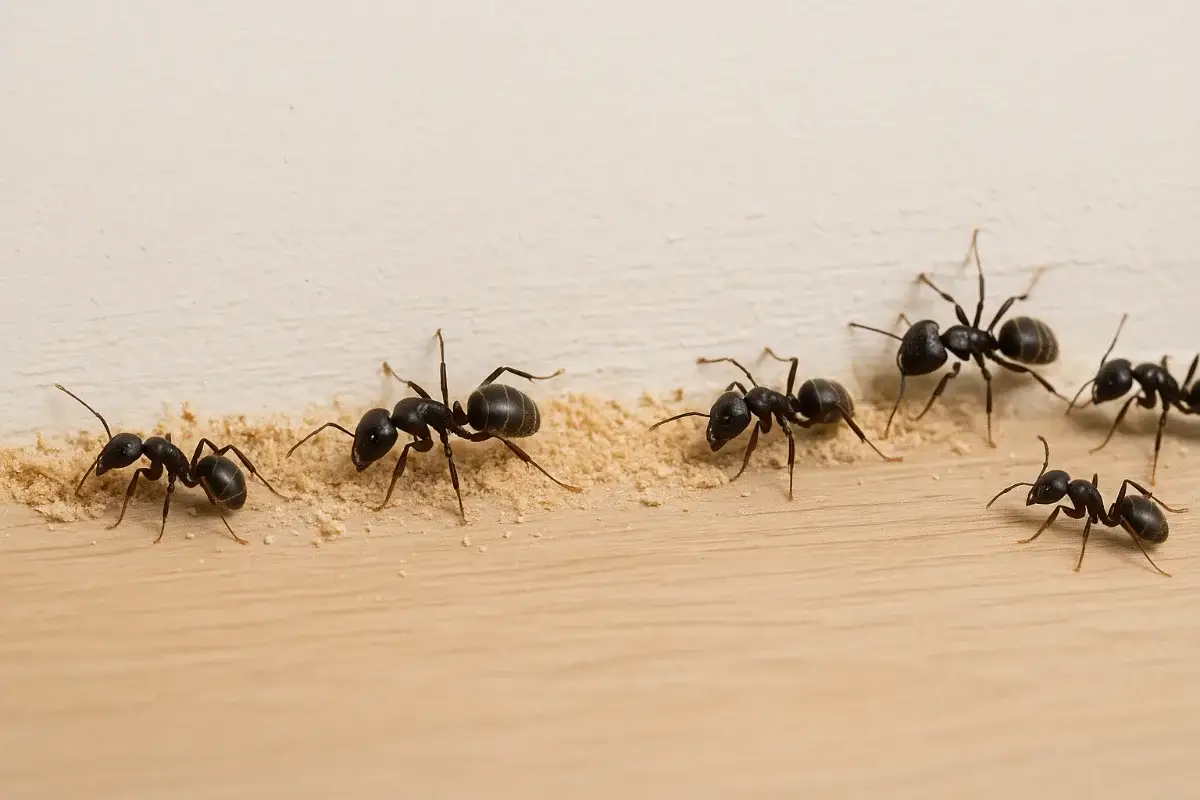
Bed bug leaves precise visual clues that any traveller can spot in under five minutes: dark frass stains on the mattress, translucent cast skins in the seams, and a characteristic sweetish odour in a confined space. Identifying these signs before sleeping in a unit keeps your personal belongings from being contaminated.
Here is the quick inspection procedure to follow when you arrive at a short-term rental:
- Put your luggage in the bathroom (tiled surface, few hiding spots) rather than on the bed or sofa.
- Lift the mattress and examine the seams, labels and corners using your phone’s flashlight.
- Check the headboard, the grooves of the wooden frame and the inside of the box spring.
- Inspect the bedding for reddish-brown stains (blood frass) or black dots (droppings).
- Look at the baseboards and electrical outlets nearby — bed bugs hide in the immediate vicinity of the sleeping host.
A bite on its own is not enough to confirm an infestation: other insects bite too. It is the combination of bites in a line or cluster, visible frass and reddish adult insects (4 to 7 mm) that makes for solid evidence. In Plateau units near Jeanne-Mance Park or avenue du Mont-Royal, triplex units share common walls, which makes it easier for bed bugs to spread between neighbours if an infestation is not treated quickly. Take time-stamped photos of everything you find — they will serve as evidence with Airbnb.
How should a traveller report an Airbnb bed bug infestation and obtain compensation?
Airbnb’s refund policy covers bed bug infestations under its “AirCover for guests” protection, provided the problem is reported through the platform within 72 hours of discovery. Reporting late or outside the platform considerably reduces your chances of being rebooked or refunded.
Here are the concrete steps to get the most out of your recourse:
- Photograph the evidence: insects, frass, bites on the skin — ideally with time-stamping enabled on your phone.
- Contact the host through Airbnb messaging (not by text or direct call) to create a written record on the platform.
- Open an Airbnb AirCover case through the “Get help” tab in the reservation — attach all the photos.
- Leave the unit if you feel unsafe or if the host does not respond within an hour of your report.
- Keep all your receipts for hotel nights or alternative accommodation to claim reimbursement of additional costs.
Airbnb may offer to rebook you in a comparable unit in the same area — which, in the Plateau, may mean moving to Mile End or Rosemont-La Petite-Patrie. If Airbnb does not handle your request satisfactorily, a complaint to Quebec’s Office de la protection du consommateur (OPC) remains a valid option for reservations made from within the province.
What are an Airbnb host’s legal obligations regarding bed bugs in Quebec?
In Quebec, any owner or manager who rents out a unit — including short-term rentals — is required to keep it in a good state of sanitation. A bed bug infestation is a breach of that obligation, whether the rental is governed by a standard lease or by a digital platform. The Tribunal administratif du logement (TAL) can hear disputes between tenants and landlords, although Airbnb stays are governed first and foremost by the platform’s contractual terms.
When it comes to pesticides, any chemical or biopesticide treatment applied in a dwelling must be carried out by a company holding a C5 or D5 subcategory permit issued by the MELCCFP (Ministère de l’Environnement, de la Lutte contre les changements climatiques, de la Faune et des Parcs) under the Pesticides Act. The company’s technicians must themselves hold the CD5 certificate. You can check an exterminator’s compliance in the Quebec government’s public register of pesticide permits.
A host who rents the unit out again right after a single biopesticide application is taking a serious risk. The recommended protocol calls for two professional visits 15 to 20 days apart to cover the egg development cycle — bed bug eggs are not affected by the first application. Renting the unit out between the two treatments can expose a new guest to the infestation and make the host civilly liable.
| Aspect | Traveller (reactive role) | Airbnb host (preventive role) |
|---|---|---|
| Inspection on arrival | Inspect the mattress, headboard and baseboards before unpacking | Inspect the unit between every stay, including on cleaning day |
| Preuve | Time-stamped photos + Airbnb messages | Log of inspections and professional treatments |
| Signalement | AirCover for guests within 24 h | Close the booking calendar as soon as you suspect a problem |
| Protecting your belongings | Luggage in airtight bags, clothes in the dryer on high heat | Certified bed bug encasements on the mattress and box spring |
| Traitement | Don't treat it yourself — risk of spreading them | 2 visits with a targeted biopesticide (MELCCFP C5/D5 company) |
| Resuming rentals | Inspect your own luggage before going home | No rentals between the 1st and 2nd application |
How should a Plateau host go about getting rid of bed bugs between two Airbnb stays?
Effectively eliminating bed bugs from an Airbnb unit relies on a two-phase protocol carried out by a professional exterminator, backed by permanent structural preventive measures put in place by the host. No over-the-counter product guarantees complete eradication of Bed bug.
The recommended professional protocol includes:
- Documented inspection before any treatment — identifying the infested areas (mattress, bed frame, sofa base, mouldings).
- First application of the targeted biopesticide Aprehend (Beauveria bassiana), an entomopathogenic fungus that kills insects on contact by colonizing their cuticle, with no persistent chemical residue for humans.
- Block the Airbnb calendar for the 15 to 20 days between the two visits.
- Second application to treat the juveniles from eggs that hatched after the first visit.
- Installation of mattress encasements — a sealed cover with a 360° zipper that traps any remaining insects and prevents new colonization.
For Plateau triplex units, particularly on rue Duluth, Marie-Anne or Napoléon, it is recommended to inform your immediate neighbours of a confirmed infestation. Bed bugs migrate through the gaps around pipes, electrical outlets and baseboards. Treating a single unit in isolation can lead to reinfestation if adjacent units are not inspected at the same time. According to the Quebec government’s guidelines on the bed bug extermination procedure, cooperation between neighbours and building managers is a condition for success.
How can you avoid bringing bed bugs home after an Airbnb stay in the Plateau?
Bringing bed bugs home after a short-term rental stay is a real and underestimated risk: a single fertilized adult female is enough to start a new infestation in your own home. Simple, systematic habits at the end of every trip break this cycle of spread.
In October, when Airbnb occupancy stays steady despite the end of the peak tourist season, the risk of staying in poorly inspected units goes up. Here are the essential precautions:
- Never put your luggage on the bed during your stay — use a metal luggage rack or the bathroom.
- Place all worn clothing in airtight Ziploc bags starting the next morning in the Airbnb unit.
- When you get home, unpack your luggage directly in the bathroom or on a hard floor, never on the bed or sofa.
- Run all clothing through the dryer on high heat for 30 minutes before putting it away in the closet.
- Visually inspect the seams, wheels and inner compartments of your suitcase — nymphs measure less than 2 mm and are easily mistaken for lint.
If you have doubts after you get back — unexplained bites, stains on the bedding — act without delay. An infestation in a condo or studio in the Plateau-Mont-Royal can quickly spread to an entire building through shared ducts. The faster the detection, the less extensive the treatment, and the smaller the impact on your lease or your daily life.
And in the neighboring neighborhoods?
- Mile End — high density of shared apartments and informal sublets, fertile ground for spread between units.
- Rosemont–La Petite-Patrie — many older triplexes along rue Masson and boulevard Rosemont, with shared walls that make it easier for bed bugs to move around.
- Villeray — dense residential area with a high proportion of tenants, where an Airbnb infestation can quickly contaminate neighbouring units.
- Hochelaga-Maisonneuve — ageing housing stock and a high rental rate increase the risk of reinfestation after incomplete treatment.
- Verdun — a growing number of short-term rentals near the waterfront, with converted units whose infestation history is poorly documented.