

The eco-friendly pest control rests on a simple principle: act at the source rather than drowning the problem in chemicals. In Montreal, where century-old triplexes, unfinished basements and urban density create conditions that favour infestations, choosing targeted methods protects occupants and the environment alike. Effective. Lasting. And often underestimated.
Understanding these methods also means recognizing their real limits. Home remedies circulate widely on forums and neighbourhood Facebook groups — peppermint essential oils, ultrasonic devices, diatomaceous earth applied any which way. Some have marginal use in very specific situations; most are not enough against an established infestation in a home in Plateau-Mont-Royal or from Rosemont. This page explains what works, why, and when a professional remains the only reasonable choice.
- Physical exclusion — sealing cracks, joints and plumbing penetrations — is the most lasting way to keep rodents and insects out.
- Moisture management eliminates the conditions that attract cockroaches, sowbugs and carpenter ants to basements and pantries.
- Slow-acting transfer baits (hydramethylnon gel, low-dose fipronil) target the entire colony without contaminating every surface in the home.
- The Aprehend biopesticide (Beauveria bassiana), used exclusively against bed bugs, kills without residue toxic to humans and without chemical resistance.
- Monitoring with traps and regular inspection detects infestations early, before they become costly — and directs treatment toward the right pest.
Physical exclusion: is the best pest control method really about closing the doors?
Physical exclusion is the most effective long-term pest control method, characterized by permanently sealing entry points, reducing internal travel routes and using rodent-resistant materials. It tackles the cause rather than the symptoms, which sets it apart from any chemical intervention.
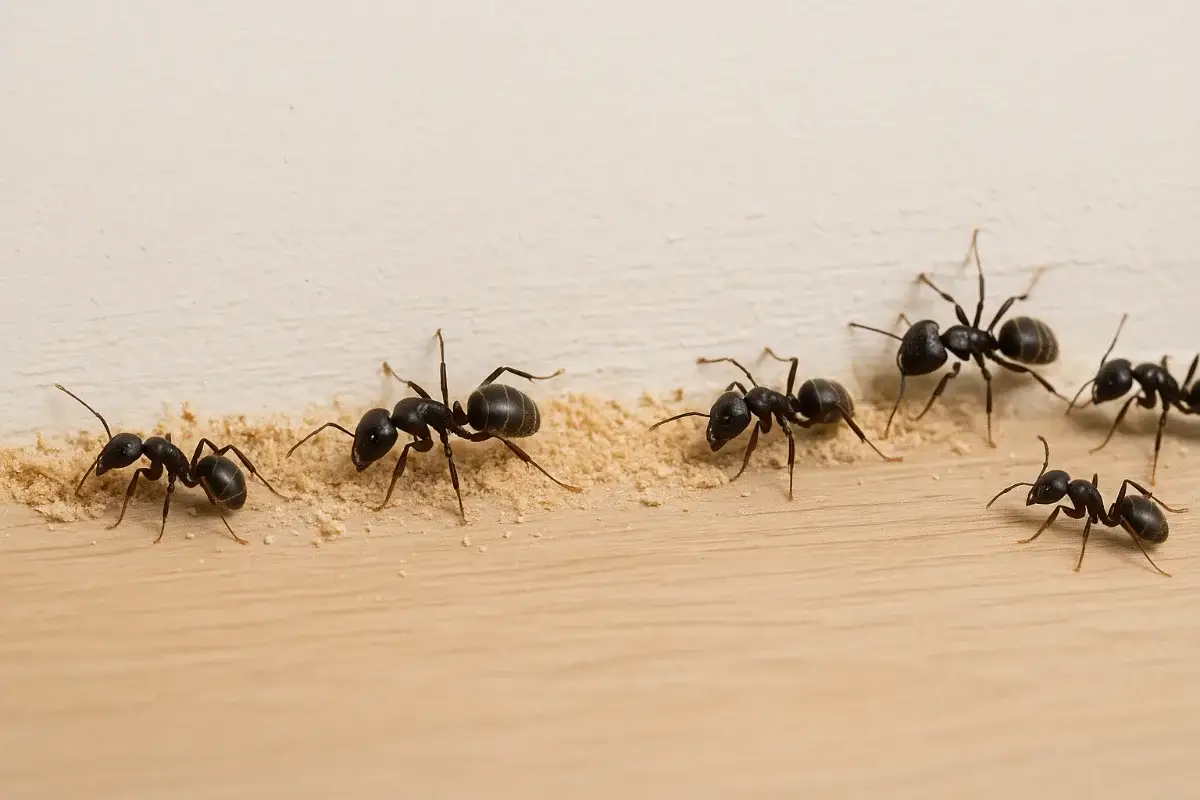
In practice, the house mouse (Mus musculus) can squeeze through an opening the size of a dime. In October, it actively looks for a way into buildings to spend the winter. In the triplexes of Villeray, from Côte-des-Neiges or from Notre-Dame-de-Grâce, pipe openings under the sink, cracks in stone foundations and poorly fitted door thresholds are invisible highways for rodents and oriental cockroaches (Blatta orientalis).
The right materials for exclusion are specific. Steel wool is packed into cracks before a silicone sealant or hydraulic cement is applied. Fine-mesh stainless steel screens block ventilation openings. Expanding foam alone is not enough: rodents chew through it easily.
- Inspect the building’s perimeter at foundation level, looking for any gap wider than a pencil.
- Check plumbing and electrical penetrations under every sink, behind the washer and in the unfinished basement.
- Fill gaps with steel wool + sealant, or have structural repairs done by a licensed contractor.
- Install thick rubber door sweeps on all exterior doors.
- Recheck these points every fall, before rodents’ winter migration period.
Exclusion does not replace active treatment if an infestation is already established — it consolidates the results achieved and prevents recurrences. A well-sealed building is fundamentally less vulnerable, whatever the neighbourhood.
Moisture, clutter and accessible food: how does pest control start with your daily habits?
Managing moisture and cleanliness is the second pillar of preventive pest control, characterized by eliminating sources of standing water, reducing organic clutter and storing food in airtight containers. Without these basic conditions, no treatment holds up over time.
German cockroaches (German cockroach), American cockroaches (Periplaneta americana), Pharaoh ants (Pharaoh ant) and sowbugs thrive in damp environments. A leak under the kitchen sink, even a minor one, is enough to sustain a colony. In newer Griffintown condos or Mile-End units with older plumbing, the relative humidity of an unfinished basement can easily exceed 70%, creating conditions that help pests settle in.
Concrete measures to put in place quickly. A dehumidifier set to 50% relative humidity in the basement changes the picture dramatically. Bulk foods — flour, grains, cereal — should be transferred into airtight glass or rigid plastic containers. The indoor compost bin needs a lid that actually closes. Stacked cardboard boxes are ideal cockroach habitat; replacing them with sturdy plastic bins in the pantry significantly reduces the available hiding spots.
These habits will not eliminate an existing infestation, but they make professional treatment much more effective. A technician who places baits in a unit where food is left out everywhere gets far less stable results.
Targeted baits or blanket spraying: which pest control approach truly respects your indoor environment?
Slow-acting transfer baits are the most targeted approach to pest control, characterized by a minimal active-ingredient concentration, placement limited to the pests’ travel areas and a cascading effect on the entire colony. They stand in direct contrast to blanket spraying, which exposes every surface.
| Criterion | Targeted baits (hydramethylnon / fipronil gel) | Broadcast spraying |
|---|---|---|
| Zone d’application | Specific transit points (joints, cracks, corners) | All accessible surfaces |
| Exposition des occupants | Very low — encapsulated micro-deposits | High — residue on counters, floors, toys |
| Effect on the colony | Gradual eradication through trophallactic transfer | Partial mortality, queens often not reached |
| Risk of resistance | Low (active ingredients can be rotated) | High (constant selective pressure) |
| Disruption to the home | Minimal — no evacuation required | Evacuation often recommended (6 hours) |
| Suitable for | Ants, cockroaches, social pests | Some cases of scattered or outdoor pests |
Hydramethylnon-based gel works through trophallaxis: one insect eats the bait and shares it with other members of its colony, including the queen and the larvae. The result: the effect spreads to places no spray could ever reach. Low-dose fipronil gel works through a similar mechanism, with slightly longer persistence.
Placement requires precise knowledge of pest behaviour. For carpenter ants (Black carpenter ant), common in the wood-frame buildings of the Plateau-Mont-Royal, bait is placed along their nighttime travel trails — not just anywhere. Poor placement gives poor results, no matter how good the product.
Biopesticides et punaises de lit : l’Aprehend est-il vraiment la révolution de la eco-friendly pest control in Montreal?
Aprehend is a biopesticide based on the entomopathogenic fungus Beauveria bassiana, used exclusively against bed bugs (Bed bug), characterized by a gradual fungal action, no chemical residue toxic to mammals and effectiveness against strains resistant to conventional insecticides. It represents a real step forward for Montreal’s densely occupied housing.
The mechanism is biological. The fungal spores stick to the bed bug’s cuticle as it crosses treated surfaces. The bug then carries the spores back to its hiding place and passes them on to other bed bugs — a transfer effect similar to that of chemical baits. Death occurs within 4 to 7 days. No resistance to this mode of action has been documented, unlike pyrethroids, to which many Bed bug populations are now resistant in Montreal and other North American cities.
According to the Quebec government’s guidance on the bed bug extermination procedure, extermination must be entrusted to a pest management company holding a business permit under the Pesticides Act — a permit issued and administered by the MELCCFP. This applies to Aprehend as it does to any other product. Individuals cannot buy or apply this biopesticide themselves.
Key point: Aprehend is NOT used for ants, cockroaches, rodents or any other pest. Mixing up applications is a common mistake. Each eco-friendly method must be matched to the right target organism — that is the foundation of rigorous integrated pest management. In a multi-unit building in Rosemont or Hochelaga-Maisonneuve, a bed bug infestation in a single studio apartment can spread to the whole floor if treatment is delayed.
Traps and regular inspection: how does preventive pest monitoring save months of treatment?
Monitoring with traps and regular inspection is the fifth pillar of eco-friendly pest control, characterized by early pest detection, precisely targeted interventions and confirmation that completed treatments have worked. It turns a reactive stance into a proactive one.
Trap types vary depending on the target pest. For rodents, glue traps or mechanical traps placed along walls (rodents travel in contact with surfaces) confirm their presence and gauge activity before you ever see one. For bed bugs, bed-leg interceptors catch insects on the move — a monitoring tool, not a control method. For cockroaches, pheromone traps show the most active areas and guide bait placement.
Regular visual inspection complements trap monitoring. In a rental building in the Sud-Ouest or in Outremont, tenants who report the first signs early — rice-shaped rodent droppings, carpenter ant frass (coarse sawdust near a beam), cockroach cast skins behind the refrigerator — make targeted treatment possible before the colony multiplies exponentially.
When should you absolutely call a professional? Four clear situations. First, if pests are confirmed but the source has not been identified after inspection. Second, if the same pest comes back after two do-it-yourself attempts. Third, if the infestation affects several units in the same building — coordination between tenants and the owner is essential, and the Tribunal administratif du logement (TAL) governs each party’s obligations. Fourth, as soon as pests with a direct health impact are detected: bed bugs, rodents with signs of urine, or wasps in living spaces. In these cases, the expertise of a technician certified under the Pesticides Act administered by the MELCCFP is not a luxury — it is the only reasonable approach.
And in the neighboring neighborhoods?
- Plateau-Mont-Royal — century-old wooden triplexes with many entry points to seal against carpenter ants and rodents.
- Rosemont–La Petite-Patrie — high rental density that helps bed bugs spread between adjoining units.
- Hochelaga-Maisonneuve — unfinished basements are common, humidity is high and oriental cockroaches are more frequent, so watch for them.
- Villeray — dense residential area with many duplexes, where preventive integrated pest management reduces recurrences.
- Côte-des-Neiges — multi-unit buildings with high tenant turnover, ideal for an ongoing trap-monitoring program.