

In November, before holiday shopping fills up the pantry, it’s the ideal time to inspect goods that have accumulated since the summer. The pantry moths in Côte-des-Neiges — and particularly the Indian meal moth (Indian meal moth) — settle discreetly into flour, nuts, and dried fruit. They often go unnoticed until an infestation is well established.
November marks the time when households stock up for holiday cookies, cakes and meals. Buying bulk flour, dates, almonds, and cashews without checking existing supplies: that is how an infestation doubles in volume within a few weeks. Spotting the signs early — silky webbing, cream-coloured larvae, nocturnal flying adults — makes all the difference.
- The Indian meal moth (Indian meal moth) is the most common species in Quebec pantries; it infests flour, semolina, nuts, dried fruit and cereals.
- Larvae produce silky webbing that stick the grains together and contaminate containers even when tightly sealed, if the infestation originates from the original purchase packaging.
- A systematic inspection before holiday shopping prevents the infestation from spreading to newly added fresh food items in the pantry.
- Transferring immediately to rigid airtight containers (glass or thick food-grade plastic) is the most effective and lasting preventive measure.
- When flying adults persist despite cleaning, a certified exterminator under the MELCCFP framework can intervene without contaminating food surfaces.
What is the Indian meal moth and why does it appear in pantries?
Indian meal moth, the Indian meal moth, is a small nocturnal moth whose two-toned wings — pale beige at the base, coppery reddish-brown at the tip — span approximately 18 mm. It is distinguished by its complete four-stage life cycle (egg, larva, pupa, adult), its creamy larva with a brown head, and its ability to spin webs in any dry food product. The adult does not eat; it is the larva that destroys food.
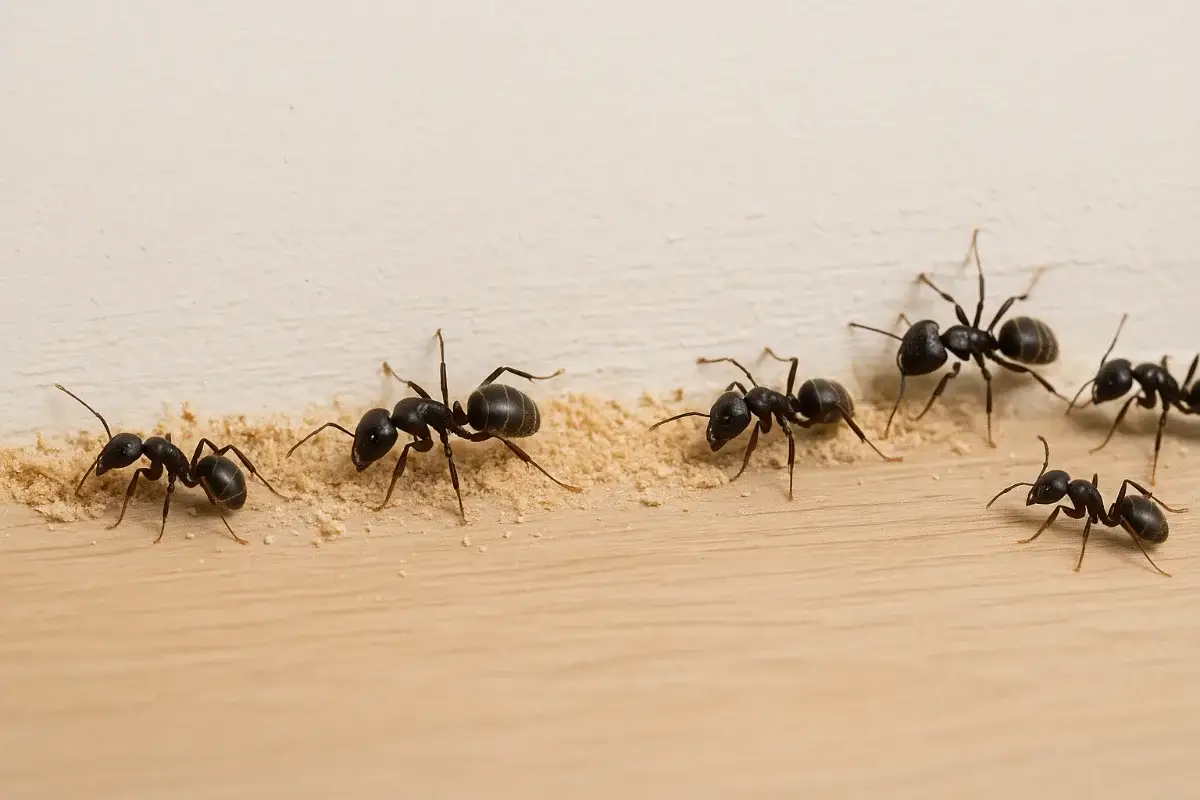
Infestations almost always start at the grocery store or warehouse, not in your home. A single punctured commercial package is enough. Microscopic eggs survive in the seams of flour bags, the folds of mixed nut packets, and the creases of imported dried fruit packaging. Once in your home, the ambient warmth of a heated apartment in Côte-des-Neiges accelerates the cycle. In November, well-heated units — condos on avenue Lacombe, triplexes around chemin Queen-Mary — maintain an interior temperature conducive to larval development year-round.
Females lay between 100 and 300 eggs directly on or near food products. Larvae pierce flexible packaging, migrate from one container to another, and spin their characteristic webbing as they progress. This silky, sticky webbing is often the first visible sign: it clumps together flour granules, nut pieces, or raisins into compact masses. A slightly sweet, rancid odour can also be a warning sign. Flying adults appear last — a sign that the infestation is already several weeks ahead.
What signs reveal a moth infestation in food products before it spreads?
The first signs of a pantry moth infestation are silky webs in the corners of containers, mobile cream-coloured larvae in flour or cereal, and small moths flying in a zigzag pattern in the kitchen at night. These three indicators often appear together — ignoring them means allowing the infestation to spread to several additional shelves.
Here are the signs to look for methodically, in order of appearance:
- Silky webbing inside or outside packaging, often in the upper corners or folds of bags.
- Unusual clumping in flour or semolina — larvae bind the grains together with their silk.
- Cream-coloured larvae from 1 to 14 mm, with a dark brown head, mobile as soon as they are exposed to light.
- Pupae in shelf corners, panel joints or behind boxes.
- Flying adults in the evening, attracted to light sources in the kitchen or hallway.
- Sweet or rancid odour coming from a container that normally has no noticeable odour.
Certain food products are particularly vulnerable: wheat and corn flour, semolina, nuts (hazelnuts, almonds, walnuts), dried fruit (raisins, apricots, dates, figs), bulk spices, breakfast cereals, couverture chocolate purchased in large formats, powdered milk, and poorly sealed whole-bean coffee. Thin plastic containers or original paper packaging pose no obstacle to a larva of Plodia.
How to inspect and clean your pantry before the Holidays effectively?
To eliminate an infestation of Indian meal moth, inspection and thorough cleaning of the pantry remain the fundamental step: discard everything that is contaminated, completely empty the shelves, vacuum all cracks, then wash surfaces with soapy water before storing items in airtight containers. Without this step, no other treatment will hold.
- Completely empty the pantry — take out every box, bag, and container without exception.
- Inspect each package under light: look for webs, larvae, cocoons, and brown frass.
- Discard ruthlessly anything infested, suspect, or with a punctured package — in a sealed bag, in the outdoor bin.
- Vacuum all surfaces : shelf corners, wood cracks, joints, edges of particleboard. Empty the vacuum outside immediately.
- Wash the shelves with hot soapy water, rinse, and allow to dry completely before putting back in place.
- Transfer unaffected food into rigid airtight containers — glass jars with silicone seals, thick food-grade locking plastic boxes.
- Do not store old and new food items together holiday shopping: use up older stock first or store it separately.
| Container type | Protection against Plodia | Practical lifespan | Notes |
|---|---|---|---|
| Glass jar with metal lid and seal | Excellent — impenetrable | Very long | Ideal for flour, nuts, and dried fruit |
| Rigid locking plastic box (with seals) | Very good if seals are intact | Long, replace worn seals | Check the seal regularly |
| Resealable plastic bag (zip-lock) | Poor — larvae can pierce thin plastic | Short term only | Do not use as a permanent solution |
| Original paper or cardboard packaging | None — easily pierced | — | Transfer immediately upon purchase if at risk |
| Metal container with screw-on lid | Excellent | Very long | Good for cookies and bulk cereals |
When should you call an exterminator for pantry moths in an apartment ?
An exterminator becomes necessary when flying adults reappear several weeks after a thorough cleaning, a sign that pupae persist in inaccessible locations — behind pantry panels, under baseboards, in caulking joints. At this stage, a professional inspection identifies hidden sources that the naked eye cannot detect.
In a rental building in Côte-des-Neiges — whether a triplex on chemin de la Côte-des-Neiges, a condo on boulevard Décarie, or a bachelor on avenue Victoria — an infestation can travel between units through common areas, shared crawl spaces, or poorly insulated shared walls. The tenant is required to report the problem to the landlord in writing. The Tribunal administratif du logement (TAL) governs the responsibilities: the landlord must maintain the unit in a proper state of habitability, which includes pest control.
In Quebec, pest control companies must hold a business permit issued by the MELCCFP (category C5 for residential premises), and each technician must hold a CD5 certificate. This information can be verified in the public registry of the MELCCFP — Permits and Certifications for the Sale and Use of Pesticides. Requiring these documents before any work is carried out protects both the tenant and the landlord.
For pantry moths, professional interventions rely on targeted inspections, crack-and-crevice treatments using approved low-impact formulations, and precise structural recommendations — without touching any food products that will remain in the room. For rodents or cockroaches that may coexist with a pantry moth infestation in a neglected pantry, the exterminator conducts an initial visit followed by a follow-up visit between 15 and 20 days later, in accordance with standard protocol.
How can you prevent the return of pantry pests after the Holidays?
Lasting prevention against pantry pests relies on three pillars: rigid airtight containers for all at-risk food items, systematic stock rotation (first in, first out), and a quick visual inspection each time new food is added. These habits, once established, eliminate the vast majority of re-infestations.
In November, with the arrival of bulk holiday purchases — five-kilogram bags of flour, assorted nuts, boxes of candied fruit, couverture chocolate — the risk of importing an infestation from the grocery store increases significantly. A few simple habits are enough:
- Inspect every package before putting it away — look for webs or holes in the plastic.
- Systematically transfer flour, semolina, and nuts in airtight jars as soon as you get home from the grocery store.
- Store seldom-used flours (almond flour, coconut flour, rice flour) in the freezer in a sealed bag — the cold stops the larval cycle.
- Clean up crumbs and residue in the corners of the pantry after each heavy use of flour.
- Avoid overstocking : buying only what will be used by the end of January limits the period of exposure.
- Inspect food gifts received (nut boxes, gift baskets) before storing them with other pantry items.
Pheromone-based sticky traps using synthetic pheromone ((Z,E)-9,12-tetradecadienyl acetate) are available at hardware stores; they capture adult males and allow you to monitor the presence of an infestation without eliminating it. They are a detection tool, not a treatment. Follow the manufacturer's instructions indicated on the packaging for the lifespan of each trap, as these vary depending on the brand and formulation.
And in the neighboring neighborhoods?
- Notre-Dame-de-Grâce — large single-family homes with unfinished basements and basement pantries present a high risk of pantry moths in long-term stored goods.
- Outremont — the renovated triplexes on avenue Bernard often hide old solid wood shelving with cracks ideal for the pupae of Plodia.
- Mount Royal — condos in the area with shared storage spaces facilitate the spread between units.
- Côte-Saint-Luc — community with a strong tradition of home cooking and large stocks of flour, dried fruits and imported nuts: a breeding ground for recurring infestations.
- Snowdon — a sector with a high density of rental units featuring shared or interconnected pantries in certain pre-war buildings.
Extermi Pro Inc. · Montreal & Laval
Dealing with pantry moths? We take care of it.
Inspection, treatment and follow-up by a certified technician, with products approved by Health Canada.
- ★ 5.0 on Google
- 6-month written guarantee
- 2 visits included
Prefer to write? Leave your details and we will call you back.