

The Wasps in the garden shed in Côte-Saint-Luc represent a common problem starting in late June, when colonies reach full strength. A simple visit to get the lawnmower or gardening tools can be enough to trigger an attack: wasps interpret any sudden movement near the nest as a direct threat. Fast. Painful. Difficult to prevent without knowing what to look for.
Côte-Saint-Luc has a large inventory of duplexes and single-family homes with backyards, which creates numerous potential nesting sites—wooden garden sheds, spaces under roofs, and old stumps repurposed as decoration. In May 2025, several residents in the Cavendish area reported discovering active nests when opening their sheds for the first time that season. The safe removal of a wasp nest requires proper protective gear and a rigorous method—not just courage.
- Wasps choose garden sheds for their darkness, retained warmth, and lack of frequent disturbance — ideal conditions for building a cardboard nest.
- Protective equipment is non-negotiable: Full protective suit, thick gloves, face veil, and watertight goggles before any intervention within one meter of the nest.
- The most aggressive species in Quebec — the German waspGerman yellowjacketand the common wasp (European wasp) — can sting multiple times without losing their stinger.
- Intervene at dawn or after nightfall reduces the number of workers present and decreases the risk of collective reaction.
- An improperly removed nest encourages re-occupation: If the queen survives or if pheromones remain in the structure, a new nest can appear within 4 to 6 weeks.
Why do wasps specifically nest in garden sheds in Côte-Saint-Luc ?
Wasps select garden sheds for three concrete reasons: protection from the weather, accumulated warmth in the wooden walls, and a low rate of human disturbance. In Côte-Saint-Luc, sheds located along backyards bordering Leblanc and Cavendish parks offer these conditions almost perfectly from May to September.
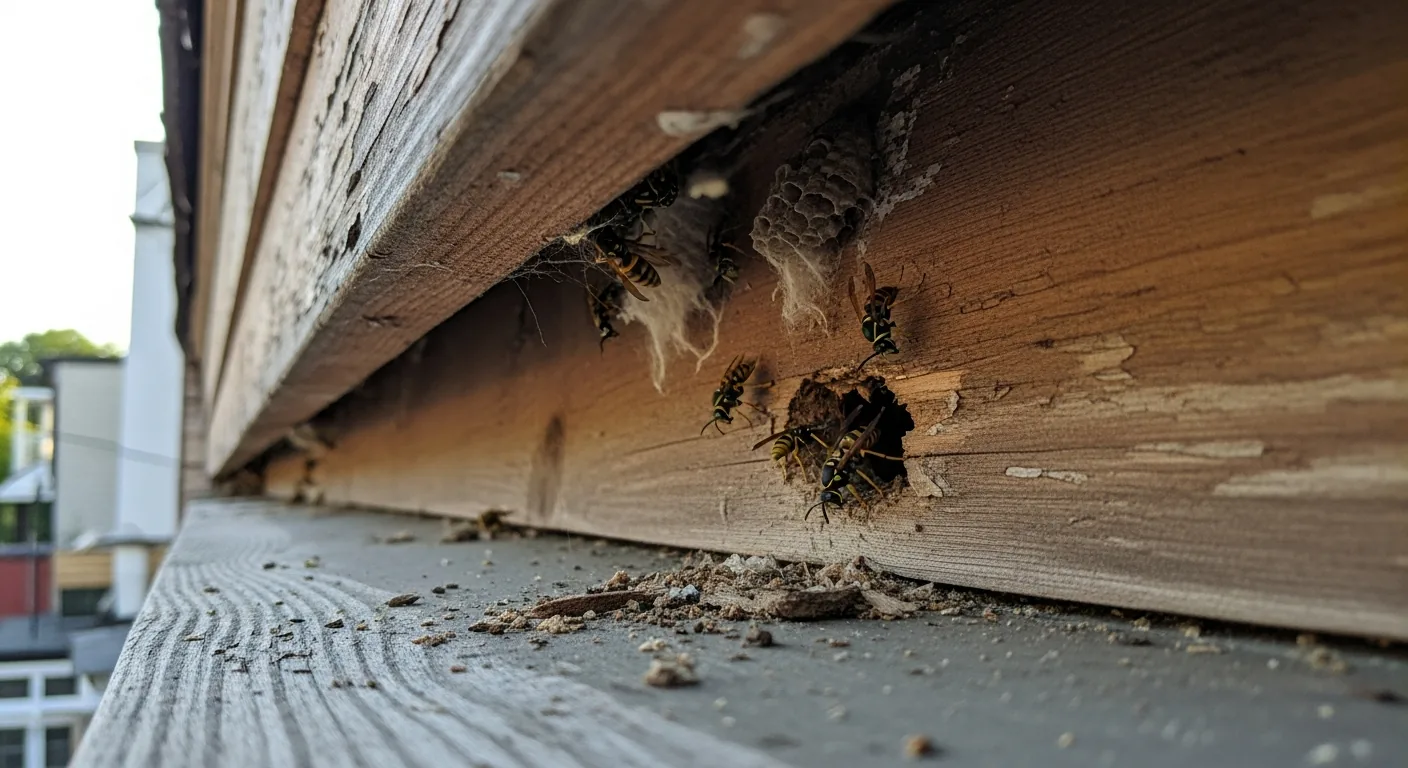
The German waspGerman yellowjacketand the common wasp (European waspare the two dominant species in the sector. They build their nests out of gray carton — a material made from chewed wood fibers mixed with saliva. The honeycomb texture is light, solid, and clings perfectly to the interior rafters of a shed or under the ledge of a shelf.
The queen becomes active at the end of April. Alone, she begins the construction of a fist-sized structure. By July, the colony can have 3,000 to 5,000 workers. A shed not often visited in the spring – classic for Côte-Saint-Luc where winter leaves equipment unused for months – gives them exactly the time needed to establish themselves solidly before the first summer visit.
Gaps around pipes, cracks between boards, and ventilation openings are common entry points. A gap of 6 mm is sufficient. Sealing these points in the fall, after the colony has naturally died off, effectively prevents reoccupation the following season.
What signs confirm the presence of a active wasp nest in your shed ?
An active wasp nest in a shed can be identified by four clear signs: a sustained coming and going of wasps at the same entry point, a deep, continuous buzzing inside, a visible gray, papier-mâché structure on wooden beams, and the presence of frass (chewed wood debris) on the ground directly below.
Frass—the residue of chewed wood fibers—is often the first visible sign on the ground, even before the nest is easily located. It resembles a grayish powder, sometimes mixed with small cylindrical pellets. Unlike traditional wood shavings, wasp frass is fine, uniform, and damp to the touch.
Also check the upper corners of walls, the spaces between the roof and the wall plate, and the back of wall shelves. These thermally stable areas attract queens looking for a nesting site. A nest being built in May is the size of a tennis ball. By mid-August, it can easily reach 40 to 60 cm in diameter.
Attention: Confusing a wasp nest with a bumblebee or hornet nest is common. Bumblebees generally nest in the ground or moss, rarely in a closed wooden structure. Yellow-headed hornets (Dolichovespula arenaria), plus rarely, build a more oval nest, often suspended under the exterior roof.
How to safely remove a wasp nest with a flashlight Personal protective equipment ?
Safely removing a wasp nest requires a seamless full-body suit with no exposed seams, thick work gloves with long cuffs, a beekeeper's veil or full face mask, and sealed goggles. Any exposed skin is a potential target. The operation should always be performed by two people.
Here is the recommended intervention sequence:
- Plan to intervene early in the morning or after 8 PM., when the majority of workers are inside the nest and less active.
- Put on the full equipment outside the shed—never inside where the wasps are already on alert.
- Apply an approved insecticide (long-acting mousse or pyrethrin-based powder formulation) directly at the nest entrance, without bright light pointed at the nest.
- Wait 24 to 48 hours before returning to inspect. The exposed workers gradually die; rushing too soon causes an intense defensive reaction.
- Physically remove the nest In a thick plastic bag, immediately reseal and place in an airtight container.
- Clean the surface with a soapy water solution to remove residual pheromones that attract new queens.
- Caulk the opening used by wasps with a sealant or mineral wool to prevent reoccupation.
| Criterion | DIY Intervention | Professional intervention |
|---|---|---|
| Required equipment | Suit, gloves, veil, goggles, insecticide | Certified professional suit, ARLA approved products |
| Allergy risk | Raised if not tested | Junior technician, on-site adrenaline junkies |
| Inaccessible nest (height, solid wall) | Impossible without specialized equipment | Suitable extraction tools |
| Elimination of residual pheromones | Partial (soapy water) | Complete — surface treatment included |
| Prevention concern | DIY (putty, wool) | Recommendations + sealing included |
At what time of year does the Risk of wasp nests in shed Is it the highest in Montreal?
The risk of a wasp nest in a shed is maximal between July and September, when colonies reach their critical size. However, the most effective preventive intervention window is in May, when the founding queen has just started her construction—the nest is small, the colony is reduced, and elimination is incomparably simpler.
From mid-October, below-zero nighttime temperatures naturally eliminate the workers and males. Only a few fertilized queens survive by hibernating in the soil or under bark. The nest itself is never reused the following season — that is a common myth. However, if the shed structure is not sealed, a new queen may choose the same location.
In August, wasp behavior changes noticeably. Developing larvae produce a sweet liquid that the workers feed on. When egg-laying slows down at the end of the season, workers lose this internal sugar source and become more aggressive, actively seeking sugars outside – abandoned cans, fruits fallen in Côte-Saint-Luc backyards, and poorly sealed garbage bins near Cavendish and Kildare streets.
This end-of-season aggressiveness is the main cause of accidental stings when storing equipment in September. Taking out garden chairs or bringing in the lawnmower without checking the back of the shed needlessly exposes you to danger.
Should one call upon Professional wasp exterminator in Côte-Saint-Luc Where can we act alone?
Calling a professional wasp exterminator in Côte-Saint-Luc becomes necessary as soon as the nest exceeds 20 cm, if it is located in a confined, difficult-to-access area, or if a household member has a known allergy to hymenopteran stings. In these three situations, attempting to handle it yourself multiplies the risk without reducing the problem.
For small nests discovered early in the season — before mid-June — and accessible without dismantling any structures, a tool-equipped and non-allergic homeowner can intervene. The condition is strict: complete equipment, approved product, and correct intervention time. No shortcuts.
This week on a duplex in Côte-Saint-Luc near Leblanc Park, a technician removed a nest of German yellowjacket 55 cm, lodged in the blind spot of a cedar shed, between the roof and a fixed storage panel. Without partially disassembling the panel, the nest was completely inaccessible—impossible to treat with spray from the entrance. The owner had attempted a first intervention himself, without success, which had made the colony even more defensive.
A certified exterminator uses insecticides approved by the PMRA (Pest Management Regulatory Agency) at concentrations and formulations not available over-the-counter. They can also use pressurized injection equipment that reaches wall voids without visible openings. Result: complete elimination in a single visit in the vast majority of cases.
And in the neighboring neighborhoods?
- Côte-des-Neiges — Frequent nests in large backyard spaces of triplexes and under exterior wooden balconies.
- Notre-Dame-de-Grâce — Community gardens along Décarie Boulevard, a high-risk area for summer nesting.
- Westmount — properties with mature gardens and stone or brick shelters, favorable conditions for German wasps.
- Verdun — untreated wooden garden sheds common in areas near Lasalle Boulevard and the river.
- Hampstead — dense residential sector with hedges and detached sheds, late discovery of nests is very common in August.